
UPS facility overtakes FedEx as world’s largest express air cargo hub
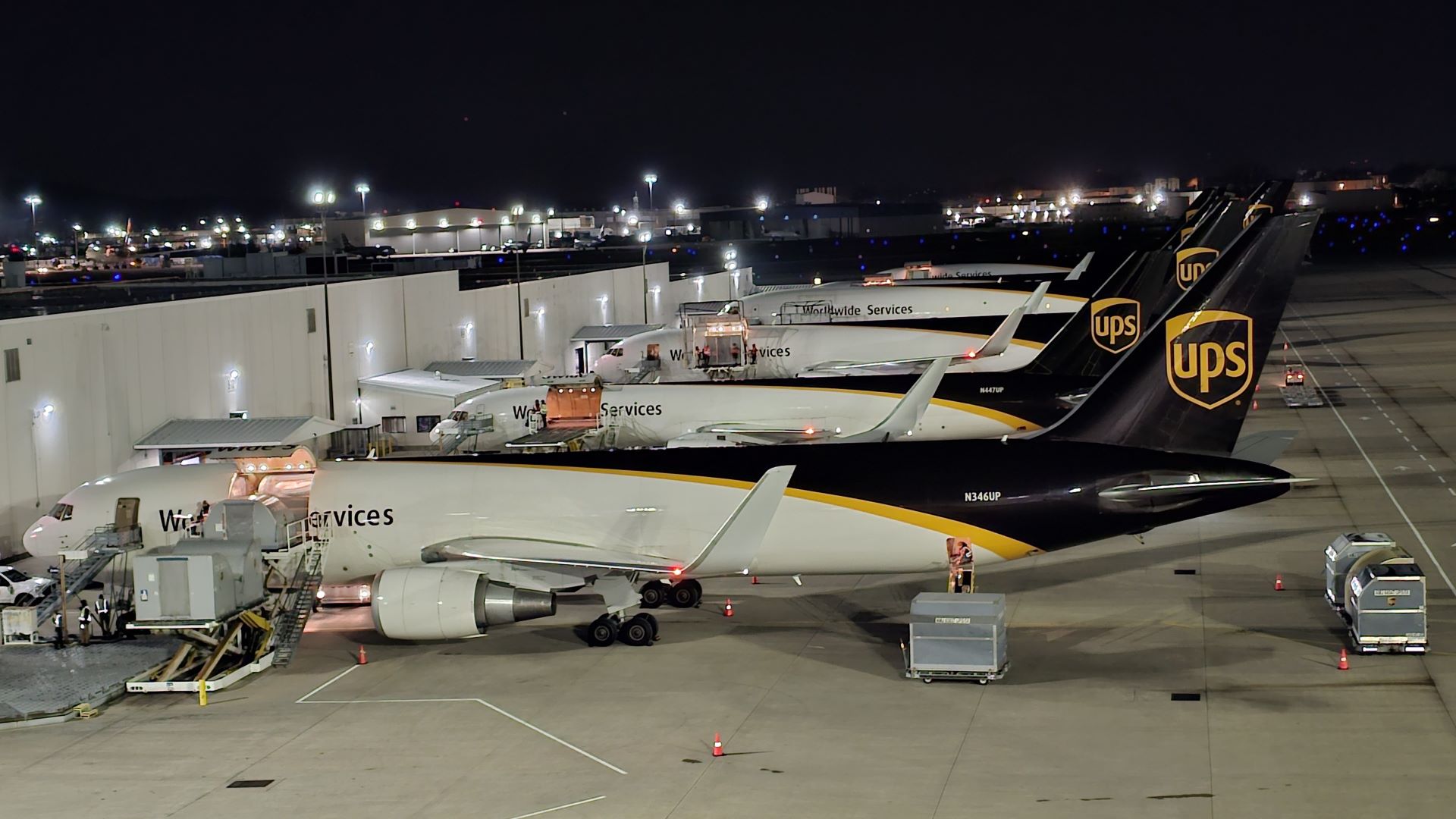
United Parcel Service’s Worldport hub at Louisville International Airport has overtaken FedEx’s home base in Memphis, Tennessee, as the largest global express air hub, according to a report from researchers at DePaul University published on Thursday.
The findings show that Louisville is now larger than Memphis across several metrics. FedEx’s (NYSE: FDX) hub still serves more airports nonstop than any other hub in the world.
The report, which analyzes flight data from Flightradar24 and aircraft size, concluded that UPS’s (NYSE: UPS) global hub claimed the top position between Jan. 17 and Feb. 19 in terms of daily flight activity, tonnage capacity and volume capacity. The Louisville hub on average handles 202 flights per day, 37 more than at the FedEx facility, during the busy mid-week period. FedEx flights have decreased 19.3% since mid-September. The majority of the flight cuts are during the afternoon.
Significantly, UPS’s Louisville hub now has 25.4% more tonnage capacity and 25.0% more volume capacity than FedEx’s Memphis on peak days, according to the report from DePaul’s Chaddick Institute.
Researchers attributed the change in pecking order to FedEx’s Network 2.0 campaign to reduce excess capacity by merging legacy Express and Ground subsidiary networks and segregating the air fleet by shipment requirements, with greater reliance on regional trucking and point-to-point flights than hub rotations for deferred heavy freight.
The network optimization strategy is expected to save FedEx $1 billion during the current fiscal year that ends May 31, according to the company.
Another factor impacting afternoon flights, and not mentioned in the report, was FedEx losing to UPS a major domestic air cargo contract with the U.S. Postal Service in September 2024.
The report also shows that Chinese hubs are rapidly growing, led by SF Airlines’ new hub at Ezhou Huahu Airport in Hubei. SF Airlines is China’s largest cargo airline by fleet size and part of parcel courier SF Express.
Louisville also outpaces Memphis in off-peak and cumulative weekly flying, followed by FedEx’s secondary European hub in Liege, Belgium; DHL’s hub in Leipzig, Germany; Ezhou airport; and the FedEx hub in Paris.
“Express cargo hubs spring to life at night when commercial passenger service is minimal. Many people fail to grasp the massive scale and intricacy of these hubs as a result,” said Joseph Schwieterman, the report’s lead author, via email.
Airports Council International, as of July 2025, ranks Memphis as the third largest cargo hub in the world, behind Hong Kong and Shanghai, by tonnage. Louisville is ranked fifth. The ACI rankings are broader and include cargo from all types of aircraft operators: passenger, freighter and express.
FedEx recently filed a site plan application with local authorities in Memphis for a major expansion of its small parcel sortation facility at the Memphis airport. The document suggests FedEx expects continued growth of e-commerce business and will require more flights to handle the extra volume.
The Chaddick Institute at DePaul is hosting a 30-minute webinar on the study open to industry professionals and others on March 5 at 12:30 p.m. CT.
Click here for more FreightWaves/American Shipper stories by Eric Kulisch.
Write to Eric Kulisch at [email protected].
RELATED STORIES:
FedEx expansion at Detroit airport boosts parcel, freight capacity
FedEx preparing major sort center expansion at Memphis air hub
The post UPS facility overtakes FedEx as world’s largest express air cargo hub appeared first on FreightWaves.