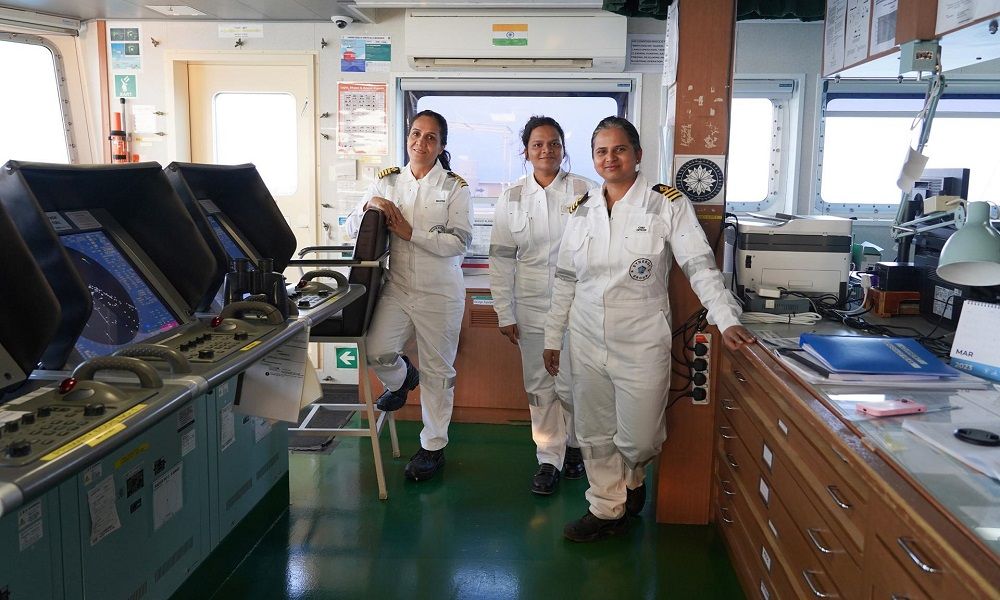
Splash canvasses the industry on how to rethink the maritime blueprint to get more of a gender balance in maritime.
For years, the shipping industry has promised inclusion. Campaigns have been launched, slogans crafted, panels convened. Yet, in 2025, women remain a rare sight on most bridges and engine rooms. The story isn’t about ability — it’s about design. The sea itself doesn’t discriminate, but the systems built around it still do.
Across shipowners, crewing managers, and welfare leaders, a growing consensus has formed: the question is no longer how to bring women to sea but how to rebuild shipping so that they stay.
Policy and practice
Karin Orsel, CEO of MF Shipping Group and former president of WISTA International, knows the limits of good intentions. Her company works closely with maritime schools and agencies to recruit women at every level and to create a workplace where they can thrive. But, she warns, progress demands more than numbers. “An inclusive culture doesn’t appear through policy — it grows from visibility and trust,” she says. MF Shipping highlights its female officers through stories, imagery, and mentorship, while enforcing a zero-tolerance stance on bullying and harassment and ensuring women’s practical needs are met on board.
Still, Orsel recognises that the system itself must change: “Improved work-life balance, safer onboard environments, mentorship programs, and visible career paths are essential.” She argues for flexible policies — such as onshore work options during key life phases — to make maritime careers sustainable over a lifetime, not just a few contracts.
That theme of policy without practice runs through much of the industry. Chirag Bhari from the charity ISWAN puts it bluntly: “We need to walk the talk. The policies developed by shipping companies must be implemented effectively.” He points to the basics — properly fitting safety gear, hygiene provisions, and awareness of maritime careers — as areas where rhetoric often outpaces reality. “Supportive policies around maternity, marriage, and flexible shore opportunities are key,” he says.
The truth is simple: infrastructure on many ships remains designed for a demographic that has dominated the industry for centuries. “Males onboard and ashore need to change their mindset,” says Tom Bonehill of Norstar Shipping (Asia).
That mindset shift is at the heart of Steven Jones’s argument. The founder of the Seafarers Happiness Index believes systemic reform must benefit everyone — not just women. “This isn’t about adding women-specific changes to a fundamentally flawed system,” he says. “It’s about creating working conditions any professional would find attractive and sustainable.”
Jones points out that most seafarers, regardless of gender, struggle with long hours, poor rest, and limited space or support. “We’ve normalised unsustainable conditions,” he says. “Until we break this cycle and build an industry worth joining, we’ll keep failing at diversity, retention, and attracting talent.”
Designing shipping for everyone
If the first step is acknowledging the gap, the second is rethinking the architecture. “Diversity isn’t a checkbox — it’s a change in current,” says Ryan Kumar from Direct Search Global, a Singapore-based maritime HR firm. “It’s not about opening the door; it’s about redesigning the whole ecosystem.”
Kumar argues that the industry must move from slogans to structure. “Young women in academies need to see real examples — not posters. Mentorship, not marketing, will drive retention,” he says. For him, inclusivity starts with visibility: women captains and chief engineers need to be visible not as exceptions, but as precedents.
He outlines three key pillars:first, designing inclusively from the start, with ships built for privacy, safety, and dignity — not retrofitted for them. Secondly, creating structured career continuity, so women don’t have to choose between motherhood and maritime. And finally, aligning culture with compliance, so professionalism outweighs prejudice.
“We don’t need women to adapt to shipping,” Kumar says. “We need shipping to evolve for women.”
That evolution is already underway in pockets of the industry. Carl Martin Faannessen, CEO of Noatun Maritime, has pushed female representation to over 6%, targeting 10% next year. “No rocket science,” he says. “We pick the best people for the job and argue for their merits.” For him, performance speaks louder than quotas. “Quota systems drive sub-optimal recruitment and retention,” he warns. “Let’s focus on excellence — and let women show they lift vessel performance.”
Faannessen credits progressive owners for backing the shift but admits that “many shoreside managers still think women onboard are great — just not on their ships.” That, he says, is where the cultural work remains.
Eva Rodríguez, HR marine director at Bernhard Schulte Shipmanagement, agrees that inclusivity must be systemic. “We have to move beyond the mentality that gives advantage to dominant groups,” she says. BSM has introduced mentorship programs linking female shore staff with women at sea and taken part in the Global Maritime Forum’s Diversity@Sea pilot project, testing new ways to make life at sea safer and more inclusive. “Equal opportunities are essential,” she says. “Bias, stereotypes, and inflexible career paths hold us back. Only by creating inclusive, safe, and fair environments can we attract and retain more women.”
From vision to practice
For many leaders, visibility is key to breaking the cycle. “The more women we show in command roles, the more others will aspire to follow,” says Captain Tanuj Balani of Stag Marine. It’s a view shared by Peter Rouch, the head of the Mission to Seafarers: “Visibility is really important. A great way of overcoming misconceptions is to provide real-life examples of successful female seafarers.”
Rouch warns, however, that visibility without reform risks sounding hollow. “Positive messaging while underlying issues remain unaddressed may not be effective,” he says. Loneliness, fatigue, and isolation continue to deter both women and men. “We must balance promotion with practical progress.”
Some companies are trying to turn talk into structure. Wilhelmsen Ship Management, under vice president for marine personnel Wiebke Schuett, has set a 10% target for female cadet intake (currently at 9%), backed by financial sponsorships through the Tom Wilhelmsen Foundation. The company also helps women transition ashore when they choose to — a key step toward making maritime a lifelong career, not a narrow path.
At Ardmore Shipping, senior vice president Robert Gaina highlights a new leadership programme, WAVES — Women on Ardmore Vessels: Empowerment and Success — to build community between women at sea and those ashore. “With 16 female officers onboard and our first female chief officer appointed, we’re proud of the progress,” he says. “Collaboration between our teams creates the support network women need to thrive.”
Others stress the need for industry-wide awareness and shared accountability. Wallem Group CEO John Rowley lists “safe onboard environments, fair career growth, maternity benefits, customised protective gear, and medical updates” as essentials — but also calls for gender awareness training for all seafarers.
From Singapore manager Union Marine Management Services, Vinay Gupta simplifies the problem: “Only one change is needed — a change in mindset.” Policies and infrastructure can help, he says, “but unless the collective mindset shifts to see competence before gender, nothing truly changes.”
That theme — mindset before metrics — runs through the new generation of maritime leadership. NSB Crewing’s Simon Frank says the industry must accept that a female seagoing career “is allowed to be different than a male one.” Accept that, he argues, and the conversation becomes more honest — and more productive.
Even among the most progressive companies, a note of caution sounds. Ronald Spithout, managing director at OneHealth by VIKAND, warns against overpromising: “Efforts to attract more women should only be pursued when companies are genuinely prepared to support them. Without robust systems, recruitment risks creating false expectations.” True inclusion, he says, “can’t be built through campaigns alone — it requires authentic readiness and visible commitment.”
An industry worth joining?
When the conversation about women at sea began in earnest a decade ago, it often focused on representation. But as the testimonies of 2025 show, the deeper issue isn’t who is missing — it’s what kind of industry they’re being asked to join.
Jones’s warning rings through: “Until we build a seafaring life that respects professionals as professionals, we’ll never attract diverse talent.” In other words, the real diversity test lies not in gender, but in quality — of life, leadership, and labour.
Orsel’s hope is that the next phase of maritime reform becomes less about accommodation and more about integration. “A regulatory structure that enables work-life balance, mentorship, and mobility will benefit everyone,” she says.
It’s a sentiment echoed by Kumar, who calls diversity “not a compliance exercise, but a long game of endurance.” The point, he adds, isn’t to count women but to keep them. “When women feel safe, seen, and supported, the whole industry becomes stronger.”
The sea has always demanded strength. What shipping must now prove is that it can match that strength with fairness — building not just ships, but systems, that are fit for the future.
To access the full Seafarers magazine for free online, click here.