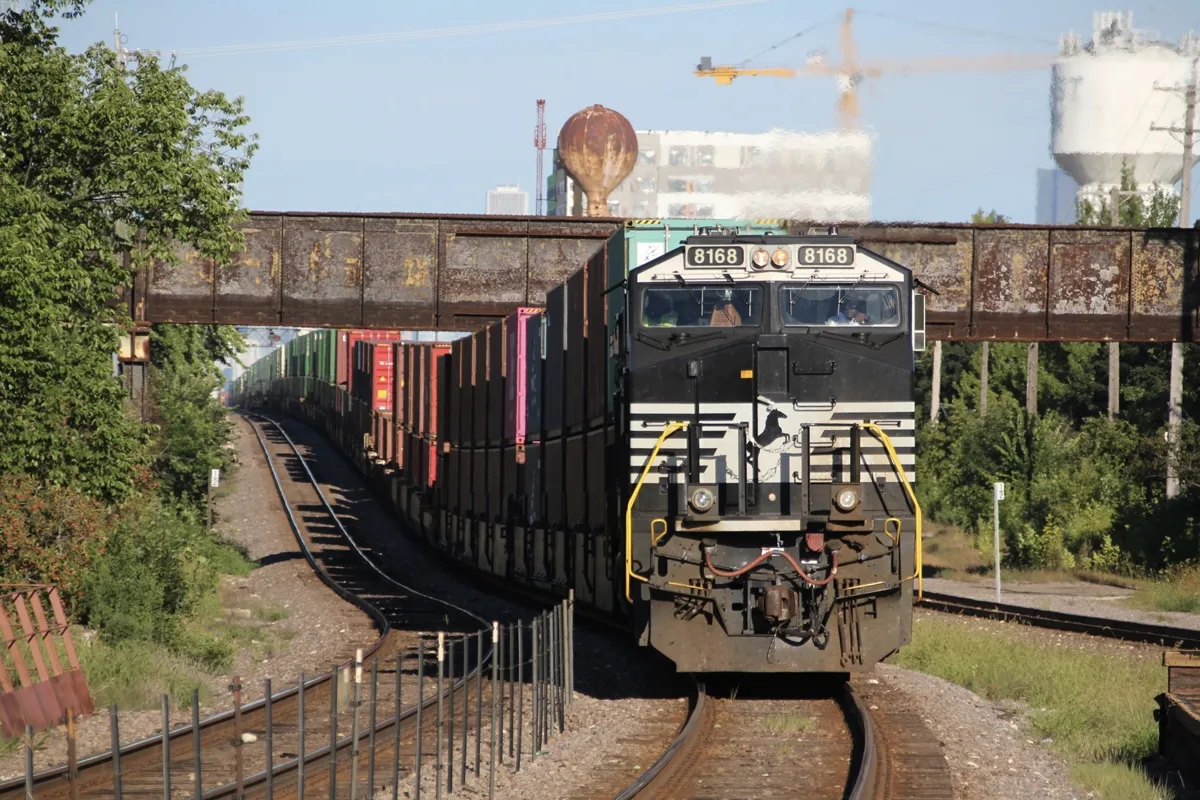
Union Pacific and Norfolk Southern defended their merger application as complete, and said federal regulators should reject the efforts, primarily by “competitors who will experience increased competition as a result of the merger,” to delay and prolong the merger process.
BNSF, Canadian Pacific Kansas City, Canadian National, and CSX all have argued the Surface Transportation Board should reject the 6,692-page application as incomplete. They cite the absence of the complete merger agreement; a lack of analysis of potential mergers that could follow the transaction and incomplete examination of the merger’s impact on competition.
Union Pacific’s 36-page response addresses and dismisses the vast majority of those arguments. It characters many as “baseless,” “unsupported,” or “misguided.”
Generally, UP (NYSE: UNP) addresses the issues in one of three ways: It says it has provided the information in question and cites where it has done so; argues that the additional information sought by the other railroads exceeds STB requirements for the application; or asserts that the complaints deal with the merits of the merger, rather than the completeness of the application, and therefore are not appropriate for consideration at this point in the process.
Among the specific rebuttals:
— UP says that the omitted material from the merger agreement — a point of contention in the CPKC (NYSE: CP), CN (NYSE: CNI), and CSX (NASDAQ: CSX) comments — “addresses the regulatory risk” between UP and NS, and “does not alter the terms of the underlying transaction. More specifically, the schedule identifies the outer limits of conditions to the merger that UPC is obligated to NSC (NYSE: NSC) to accept. Commenting parties’ interest in information is obvious: they would have a tremendous benefit in bargaining for concessions if they knew UPC’s bottom line.”
It further says the other railroads may disagree with UP’s assertion that the material is privileged, “but such issues can and should be adjudicated through the discovery process. A discovery dispute … is not a basis for rejecting the Application as incomplete.”
— Countering claims by CPKC and BNSF (NYSE: BRK-B), UP says the application includes the data underlying its assertion the merger would lead to 2 million truckloads of traffic moving to the railroad, in the form of “workpapers [that] include all the truck movements identified for diversion at a county-to-county level of detail.” CPKC noted in its comments that it had been quoted a price of $399,000 to obtain the underlying data, but UP says the “implicit claim” by BNSF and CPKC that it should purchase data licenses “to underwrite the cost of their voluntary participation in this proceeding … is inconsistent with black letter legal rules requiring parties to pay their own litigation cost.”
NS response focuses on Virginia port short line
Norfolk Southern’s response, meanwhile, focused on CSX’s effort to require a separate proceeding over control of the Norfolk & Portsmouth Belt Line Railroad, subject of an NS-CSX dispute already before the board. NS characterized the request as an effort by CSX “to obtain regulatory conditions to give it an unearned advantage at the Port of Virginia, specifically at the Norfolk Intermodal Terminal.”
It says a separate proceeding is not required because the application asks to acquire whatever interest in the NPBL is held by NS once the board rules. “In short,” NS argues, “CSX asks the Board to require UP to file an application based on assumptions the Board has not yet decided, conditions the Board may never impose, and ownership interests NS may never hold.”
UP similarly says the CSX request for a separate proceeding regarding control of the Terminal Railroad Association of St. Louis – a local carrier that interchanges cars between railroads – is unnecessary. It notes that the application commits to divesting the NS share of TRRA to the other owners, BNSF, CN, and CSX, to keep UP post-merger ownership in TRRA below 50%. UP and NS include a request for authority to control the TRRA in the application, UP says, “solely because such authority would become necessary in the event they are unable to complete the planned divestiture before they are allowed to consummate their transaction.”
The STB will now determine whether to accept the application as complete. The board in 2021 turned down CSX’s application to acquire Pan Am Railways before accepting an updated application two months later. The initial application for the Canadian Pacific-Kansas City Southern merger in 2021 was accepted by the board, despite objections by UP, CN, CSX, and BNSF.
Subscribe to FreightWaves’ Rail e-newsletter and get the latest insights on rail freight right in your inbox.
Related coverage:
Short line rail operator R.J. Corman president Goss retires
GATX, Brookfield complete buy of Wells Fargo rail leasing
Amtrak turns down ‘Transcontinental Chief’ proposal: Report
North Shore unveils US semiquincentennial locomotive
The post Union Pacific, Norfolk Southern defend completeness of merger application appeared first on FreightWaves.