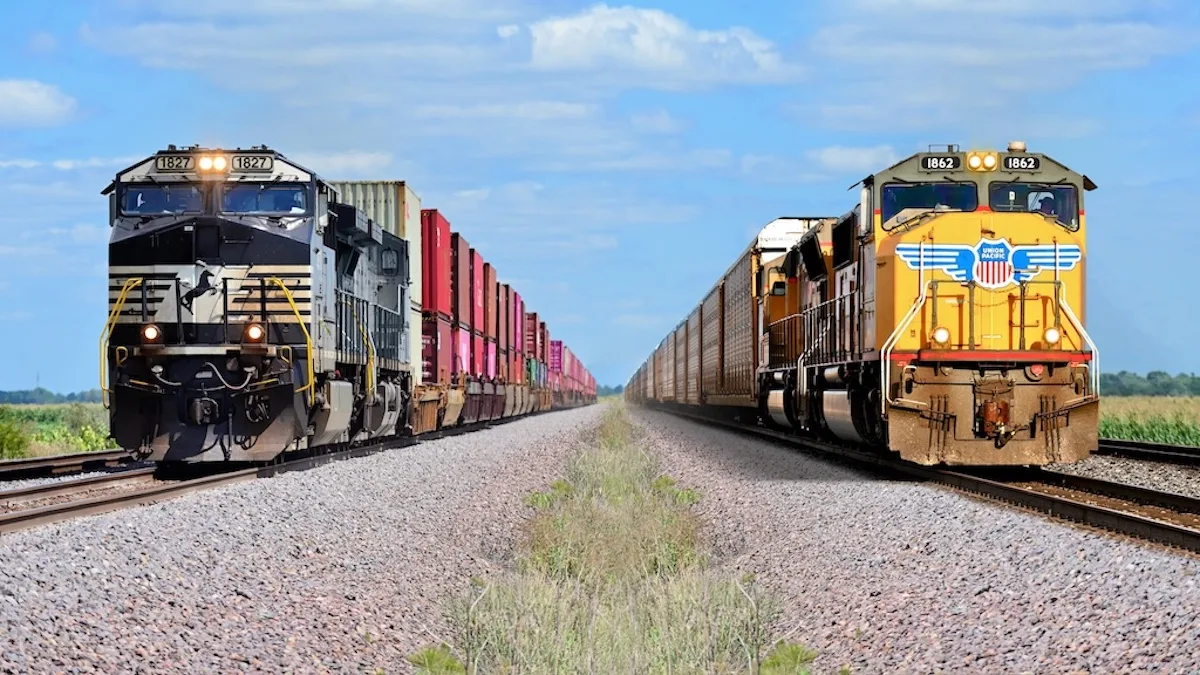
Union Pacific and Norfolk Southern on Friday submitted a comprehensive application to the Surface Transportation Board requesting approval to combine the two major freight railroads into what would become America’s first transcontinental railroad.
The filing represents a landmark moment in American transportation history, proposing the creation of a unified rail network spanning the nation from coast to coast. The nearly 7,000-page application provides extensive details on how this end-to-end combination would enhance competition throughout the freight industry while delivering substantial public benefits to customers, employees, and communities across the country.
The merger agreement between the two companies was initially executed on July 29, 2025, setting the stage for this regulatory filing. The application highlighted 2,000 letters of support from stakeholders. Shareholders at both Union Pacific (NYSE: UNP) and Norfolk Southern (NYSE: NSC) earlier voted 99% in favor of the proposed transaction.
The merger has also drawn opposition from trade groups including chemical and energy shippers, unions representing locomotive engineers and track workers, and rival carrier BNSF.
The two companies expect the merger to be completed by early 2027, pending regulatory review and approval within the statutory timeline established by the STB.
Creating a transcontinental network
The proposed combination would unite Union Pacific’s expansive western reach with Norfolk Southern’s access to eastern manufacturing and population centers. Union Pacific currently operates across 23 western states. Norfolk Southern operates a 22-state network in the eastern United States, with connections to every major container port on the Atlantic coast as well as major ports across the Gulf Coast and Great Lakes.
The combined entity would create a network encompassing 50,000 route miles in 43 states and more than 100 ports. Union Pacific Chief Executive Jim Vena emphasized the importance of the merger in adapting to changing freight delivery demands, stating that as time and technology continue to transform how freight is delivered, the industry must keep pace and move forward, reaching underserved markets with new rail solutions and strengthening the United States supply chain. Vena expressed confidence that customers deserve stronger, more connected freight rail, and that the merger would deliver on that promise.
Norfolk Southern President and CEO Mark George highlighted the complementary nature of the two networks, explaining that the combination would bring together Union Pacific’s expansive western reach and Norfolk Southern’s access to eastern manufacturing and population centers in an end-to-end combination. The result would be a unified rail system capable of bridging the gap between east and west, allowing freight to bypass congested interchanges and take the fastest and most efficient, price-competitive route.
Enhanced competition and operational efficiencies
The Union Pacific-Norfolk Southern combination represents a classic end-to-end merger, with each railroad currently serving distinct geographic regions with complementary networks, customers, and markets. Unlike mergers that might reduce competition by combining overlapping services, this transaction would connect two systems that have historically operated independently in their respective territories. The application notes only three customer locations out of more than 20,000 served would be impacted by both railroads serving them exclusively, and competitive shipping alternatives would be retained for these locations.
One of the most significant operational improvements promised by the merger involves the transformation of interline service into single-line service. Currently, shipments moving across the country must be handed off between railroads, creating delays and inefficiencies. The combined company would convert 10,000 existing lanes from interline service requiring time-consuming handoffs into faster, more efficient single-line service. This improvement would eliminate an estimated 2,400 rail car and container handlings and 60,000 car-miles each day, dramatically improving the speed and reliability of transcontinental freight movement.
The companies point to research demonstrating that when single-line rail service is available, the share of freight traveling by rail versus highway is roughly two to three times greater than with interline service. This finding suggests that creating a seamless transcontinental network would fundamentally change the competitive dynamics between rail and trucking, particularly for long-haul freight movements.
Benefits for customers
The merger application outlines numerous benefits that customers would realize from the combination. Faster, more efficient service represents the cornerstone of customer benefits, with the integration creating an additional 84,000 county-to-county lanes where shippers currently moving freight by road could, for the first time, utilize single-line rail service. This expansion of service options would provide shippers with alternatives they have never previously had access to.
The combined railroad has announced plans to introduce several new routes as part of its optimized operating plan. Two new daily intermodal train pairs would connect the east and west with more direct service, reducing estimated transit times from Southern California to the Ohio Valley and Northeast by up to 20 hours. Service from Southern California to the Southeast would see transit time reductions of more than two days. Additionally, six new manifest trains would be introduced to bridge the east-west divide more efficiently, reducing over 600 daily car handlings. To meet expected intermodal growth, the combined company plans to introduce a total of six premium intermodal lanes operating seven days a week.
Customers who own rail cars would benefit from improved productive use of their assets. With faster, more predictable service, customers can turn cars more quickly, minimize idle time, and lower equipment costs. The unified digital experience promised by the merger would allow shippers to integrate scheduling, tracking, and shipment visibility through a single platform. Customers would benefit from having one commercial team, one contract, one invoice, and one accountable partner for their entire rail journey.
The application introduces Committed Gateway Pricing, a voluntary enhancement designed to further competition by streamlining pricing of interline moves for thousands of customer locations that otherwise may not directly benefit from the merger. The combined company would keep all existing gateways open for eligible traffic on commercially reasonable terms. As an added protection for customers, Union Pacific would voluntarily create an alternative dispute resolution program to efficiently address certain claims regarding merger-related service issues.
Short line railroads would also benefit from the merger. As Union Pacific and Norfolk Southern create new single-line routes, open competitive markets, and streamline service, short lines are positioned to capture new volumes flowing directly onto their rails, potentially spurring growth throughout the regional rail network.
Nationwide economic benefits
The merger promises substantial economic benefits for the nation, particularly for regions that have historically been underserved by rail transportation. The application identifies what it terms the upper midwest watershed region, an area where trucking was often the only viable option because crossing the divide between eastern and western railroads made rail service too expensive and complicated due to handoffs between carriers. This previously underserved rail market would gain access to single-line manifest service for the first time.
The railroads quoted industry consultant Oliver Wyman estimates that 105,000 carloads of merchandise traffic would convert from road to rail when single-line service becomes available to the watershed markets. By providing domestic shippers with a cheaper alternative to truck transportation, the merger would make American businesses more competitive, strengthening the entire national economy.
The seamless transcontinental railroad would compete more aggressively with long-haul trucking, with the companies estimating that approximately 2 million truckloads of freight annually would shift from road to rail. This modal shift would reduce congestion on America’s highways, create safer roads for motorists, and decrease wear on taxpayer-funded infrastructure. The benefits would extend beyond the freight industry to all road users and the government agencies responsible for maintaining highway systems.
The combined network would provide efficient, flexible, and reliable single-line access to more than 100 ports connecting to global markets and 10 international gateways to markets in Canada and Mexico. This enhanced connectivity would strengthen the position of American businesses in international trade and improve the resilience of the national supply chain.
Environmental and sustainability benefits
Rail transportation already represents the most sustainable way to move freight over ground. According to the Association of American Railroads, rail shipping produces roughly 75 percent less carbon emissions than trucks. The merger would further enhance these environmental benefits through multiple mechanisms. Removing an estimated 2 million trucks from the road annually would directly reduce transportation-related emissions. The combined company would also be positioned to run trains more efficiently, invest in cleaner and more efficient technologies, and provide customers with better tools to achieve their own sustainability goals.
Protecting railroad employees
The application addresses workforce considerations with commitments designed to protect railroad employees. The companies pledge that every employee with a union job at the time of the merger will continue to have one following the combination. Union Pacific has formalized groundbreaking jobs-for-life agreements with multiple unions, providing unprecedented job security for represented workers. Any merger-related union job efficiencies would be achieved solely through attrition rather than layoffs.
Beyond job protection, the companies expect the combined entity to grow, creating approximately 900 net new union jobs by the third year following the merger to handle expected volume growth.
Safety considerations
Safety remains the highest priority for both railroads, and the application includes a comprehensive safety integration plan developed in collaboration with the Federal Railroad Administration and submitted to the STB. The plan outlines how the new company would combine best practices from each railroad to further enhance safety outcomes.
Both companies have demonstrated significant safety improvements in recent years. Comparing the first three quarters of 2023 to the same period in 2025, Union Pacific improved its personal injury rate by 41% and now leads the industry in employee safety. Norfolk Southern’s advanced technologies and industry-leading rail safety practices have improved its Federal Railroad Administration accident rate by 45% over the same period. The merger would allow both companies to share their respective safety innovations and best practices, potentially accelerating safety improvements across the combined network.
The application also addresses passenger rail considerations. Union Pacific and Norfolk Southern would maintain dedicated systems to support passenger rail operations. A route-by-route analysis of projected volume growth verified sufficient capacity to continue fulfilling all service obligations to Amtrak and commuter rail agencies, ensuring that the freight merger would not adversely impact passenger transportation.
The companies anticipate investing an estimated $2.1 billion of incremental capital to integrate the two systems and deliver benefits to customers. The combined company also expects $133 million in annual capital synergies by leveraging the combined network and fleet more efficiently.
The application is now subject to a 30-day review by the STB for completeness. The formal evaluation could take a year or longer. Following approval, the combined company would continue to operate under ongoing STB oversight.
Subscribe to FreightWaves’ Rail e-newsletter and get the latest insights on rail freight right in your inbox.
Find more articles by Stuart Chirls here.
Related coverage:
‘Application day’ nears for UP-NS rail merger
Unions oppose historic transcontinental rail merger
Union Pacific completes Arizona yard expansion
Union Pacific adds retiring CF Industries CEO to its board
The post Union Pacific and Norfolk Southern file historic rail merger application appeared first on FreightWaves.