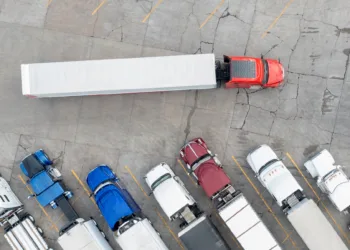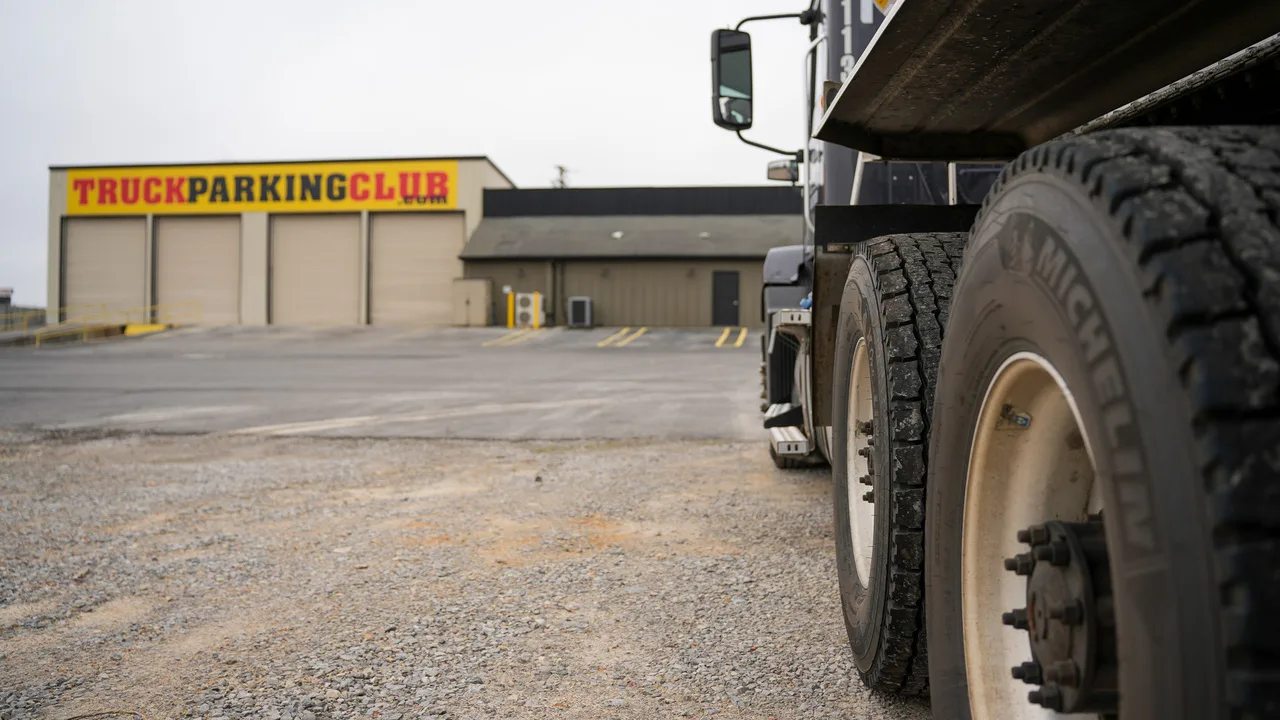
Truck Parking Club, the digital marketplace connecting commercial drivers with private parking spaces, announced it has reached 4,000 Property Member locations across 49 states, with plans to more than double that figure to 10,000 locations by the end of 2026.
The Chattanooga, Tenn.-based company added 1,000 locations in just three months and now offers over 66,000 instantly reservable truck parking spaces, addressing a national shortage of 1.7 million spaces that costs the trucking industry more than $100 billion annually.
Its rise is meteoric. The platform’s growth has attracted major carriers, with 92 of the top 100 U.S. carriers now using Truck Parking Club. The company was recently ranked No. 24 on the FreightWaves FreightTech 25 list for 2026.
To better understand the growth story, FreightWaves spoke with Reed Loustalot, chief marketing officer at Truck Parking Club.
Growing from 4,000 to over 10,000 locations would more than double the company’s footprint.
The math is straightforward, if daunting: add 6,000 new properties in roughly 11 months. That means recruiting thousands of individual business owners who have never considered parking semi-trucks as a revenue stream.
To accomplish this, Loustalot describes the recipe for success as extreme amounts of work and building a community and ecosystem to support it.
Beyond the milestone: A remarkable growth story
Loustalot doesn’t want the story to just be about hitting big round numbers. Reaching those numbers has taken Truck Parking Club on an odyssey in search of additional pavement to book.
Loustalot noted Truck Parking Club attended over 70 shows last year to expand reach and respond to feedback that the platform solves problems across the supply chain.
“That could be a storage company or a repair shop or a trucking company or a warehouse,” Loustalot said. Year to date, the company has already attended seven trade shows by early February.
Some of the biggest contributors are trucking companies with yard space, repair shops, self-storage facilities, towing companies and even third-party logistics providers with extra yard space. The variety of potential places to park translates into endless leads.
Truck Parking Club’s efforts have taken it to dozens of supply chain conventions, including self-storage shows, trucking conferences, towing shows and retailer conventions — anywhere a company with extra space might consider listing a spot.
“You’re going where they go,” Loustalot said. “And there’s a reason we do this.”
He described the strategy as a shotgun approach. “It’s a shotgun because it’s literally how wide our market is. And if we’re serious about adding 6,000 locations in 11 months, we have to cast as wide a net as possible while maintaining a high bar for quality and thoroughly vetting what we actually onboard to the app.”
There is a method to the madness, and it runs through the community the company has cultivated.
The right partners and the value of skin in the game
Behind the growth numbers lies a business model that Loustalot describes less as a tech platform and more as stewardship of small-business communities. When a driver books a spot through Truck Parking Club, the majority of every transaction goes directly to the property owner — whether that’s a family-owned repair shop in Akron, Ohio, or a regional trucking company with extra pavement.
“When you park at Rick’s Repair Shop in Akron, Ohio, and you pay with Truck Parking Club, you’re paying Rick,” Loustalot said. “In a way, I think we really need to talk more about how we’re building essentially an ecosystem of all these local businesses and drivers and fleets, and they’re essentially transacting and meeting, and we’re kind of the stewards of that community.”
The company acts as gatekeeper: handling onboarding, customer service and quality control. But the core is an ecosystem where hosts and drivers transact directly, with built-in incentives to keep standards high.
Drawing a comparison to ride-sharing platforms, Loustalot explained how accountability drives quality. The company has accumulated many tens of thousands of reviews across its properties and plans to make ratings affect visibility to drivers.
“It’s like Uber,” Loustalot explained. “A good rating keeps quality high because hosts know they need to deliver a great experience to stay visible. Drivers review seriously because they know the next person relies on that information.”
Unlike government-funded parking projects that may lack long-term maintenance incentives, property owners on the platform have financial motivation to keep their lots in good condition. If they want to continue earning revenue, they need to maintain positive reviews and provide reliable service.
“The only way we provide an excellent experience at that volume is by creating a system where properties are incentivized to improve based on feedback,” Loustalot said.
“Bar none, our aim is to provide drivers an excellent experience,” he added. “They know they’re going to have a spot, they can rely on it, they know they can trust the listing page, they know they can trust the photos, they know they can trust the reviews.”
Winning over both drivers and their fleets
Loustalot noted one recent trend is the nation’s largest trucking fleets warming to the idea of paying for driver parking.
“Not many do it yet,” Loustalot admitted, “but more will. We’re removing the traditional reasons they said no.”
For large fleets that are onboarded, Truck Parking Club’s biggest champions are often the drivers themselves.
Company drivers regularly tell Truck Parking Club that they pay for parking themselves to avoid trading $10 for an extra 50 or more miles of productivity. Parking peace of mind translates into more miles and a larger paycheck.
The company is working to convert more fleets into paying for their drivers’ parking, addressing traditional barriers.
“If historically what it’s meant for a big fleet to pay for a driver’s parking is either you just blindly trust the random receipt that your driver gave you or you don’t, and then go through the work of building the infrastructure to reimburse that money on paychecks,” Loustalot said. “We remove all of that because a fleet with us has one source of truth for payments and receipts.”
Fleet managers can track every location, payment and booking frequency. They can view photos, security features and available amenities for each location their drivers use.
It can also be a cash-generating option for fleets with a large real estate footprint. Many large carriers own or lease yards with underutilized space. The platform allows them to monetize that excess capacity while providing solutions where they need additional storage.
“I don’t care if it’s five trailers or 500 trailers,” Loustalot said. “I don’t care if it’s one location or 100 locations. We’ve done it all.”
The business case for fleet-paid parking extends beyond driver retention. Safety concerns play a role, as drivers parking in unauthorized locations create liability. Asset utilization matters too. When drivers shut down four hours early because they’re uncertain about finding parking, both the company and driver lose money.
Loustalot adds that for smaller fleets that can’t afford real estate, temporary or long-term parking can help them grow their business.
“We’ve had carriers tell us they have customers asking them to do projects in Ohio, and the carrier says no because they don’t have a yard there,” Loustalot said. “We can literally, on a month-to-month basis, give them access to flexible storage space.”
This flexibility allows carriers to take on new business without committing to multi-year leases.
Enhancing driver flexibility and the Super Trucker Membership
The flexibility theme extends to drivers as well. The company recently launched its first membership subscription, called the Super Trucker Membership, priced at $9.99 per month.
Members receive 5% back on every booking compared to the standard 1% return for non-members. The rewards accumulate in what the company calls “Club Cash,” a wallet feature tied to user accounts.
The membership also provides five free refunds and five free booking changes per month. Previously, all bookings were non-refundable due to the payment system structure. Now members can cancel and receive their money back in Club Cash for future bookings or move a reservation to a different date, all through the app without calling customer service.
“This is ultimately all about providing flexibility, because that’s how drivers are most affected,” Loustalot said. “They have flexible options, they have limitless places to park, and they always know they’re going to have a spot. That’s the world we’re trying to create.”
The platform serves diverse use cases beyond standard overnight parking. Drivers use the service for storing trucks near their homes, taking 34-hour resets near attractions and parking during vacation time.
“We hear stories like using a spot for five days so we could go to the Macy’s Thanksgiving Day Parade,” Loustalot said. “We’ve got a bobtail location on the beach in Florida, and there’s people there all the time. You think they’re just hanging out in the truck? No, they’re going to the beach.”
Looking ahead: Locations as service nodes
Loustalot doesn’t shy away from ambitious predictions about Truck Parking Club’s trajectory. Within three years, he expects the company to become the largest single entity parking trucks in the United States — handling millions of bookings annually.
“That is where we will be in not a very long time,” Loustalot said. “And if it takes three years, it takes three years. That’s not a long time.”
The long-term vision extends beyond parking reservations. Loustalot describes each location as a “node” around which useful services for truckers can aggregate: food, repairs, potentially even electric vehicle charging — whatever the market demands.
“Every single one of our locations is its own little node,” Loustalot said. “And the services that are useful to truckers will aggregate around the nodes. Food, repairs, charging, whatever services the market demands will appear.”
The company has already seen some electric vehicle charging companies list spaces on the platform — not for charging yet, but because they have unused space while infrastructure is built out. Formal partnerships remain on the horizon.
“Any one of those folks is welcome to work with us right now,” Loustalot said. “As time goes on, we’ll pay attention to what there’s demand for, and how it would work, and how it would improve the experience drivers would have with us, and we’ll evaluate it.”
The ultimate goal, Loustalot said, is a world where drivers have unlimited, reliable options — where the anxiety of finding a spot disappears entirely.
“That’s the world we’re trying to create,” he said. “Drivers have flexible options. They have limitless places to park, and they always know they’re going to have a spot.”
The post Truck Parking Club hits 4,000 locations, targets 10,000 by year-end appeared first on FreightWaves.