NEW ORLEANS–The argument about whether having cameras in a driver’s cab and on the outside of the vehicle is largely over. Holdouts on the issue are dwindling in number.
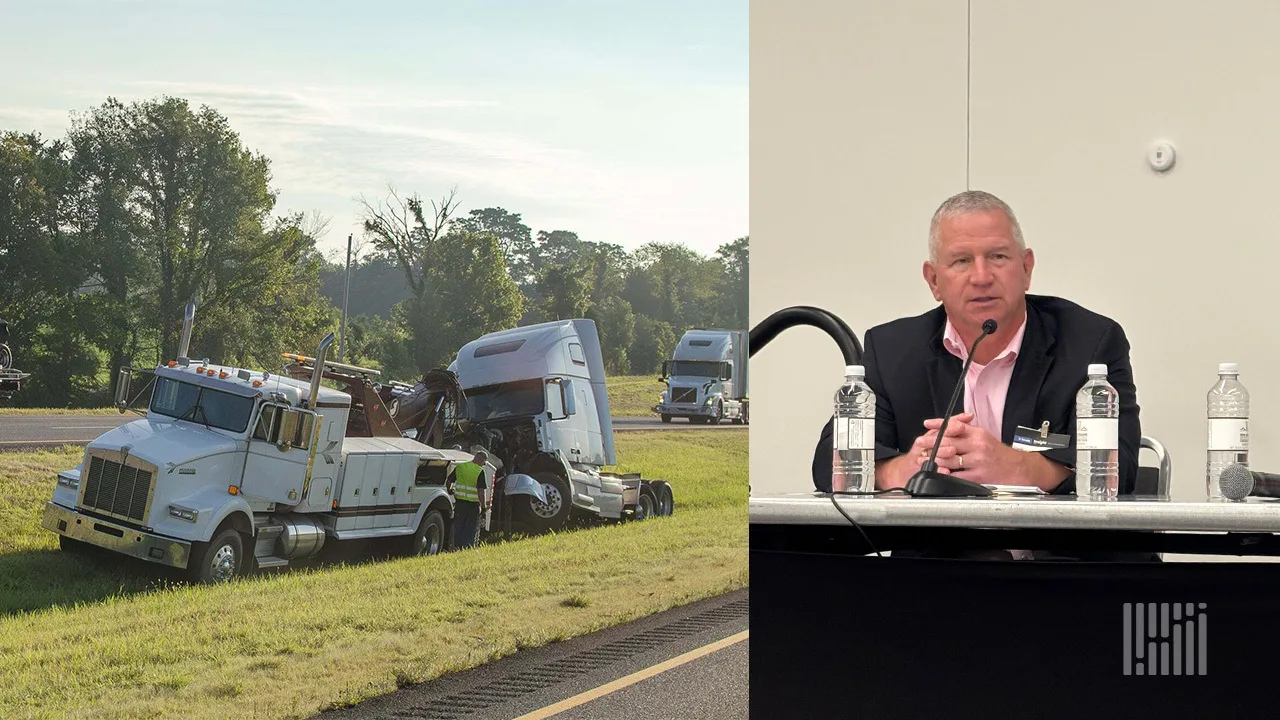
But just because the cameras are in place doesn’t mean the discussion ends there. How a trucking company uses that equipment to protect itself was the subject of a presentation at the Trimble Insight (NASDAQ: TRMB) conference here by Rob Moseley, partner in the Moseley Marcinak Law Group of South Carolina that focuses almost exclusively on trucking, defending carriers and brokers.
Moseley laid out in his discussion the do’s and don’ts of camera policy. It is a surprisingly long list of thorny questions that develop over time as companies that have equipped their trucks with cameras seek to craft policies about their use and the subsequent streams of data provided by the cameras.
The overriding foundation of trucking law that supports the use of cameras was spelled out by Moseley. “In the world that we’re in today, you have to prove that you’re innocent, not the other side having to prove you did something wrong,” he said.
Cameras are an important part of that. Moseley, noting that he was making his comments “carefully,” said that “sometimes drivers lie, or they might not tell you the truth about what happened.”
But it isn’t all deceit, he added. A driver might not truly understand what happened on the road. “They’ve just been through a very traumatic event,” he said. “They’re full of adrenaline. Whatever they spout out next may or may not be true.”
Moseley followed that up with what can best be described as the “value prop” for cameras.
Driver memories aren’t perfect
Videos mean a company does not need to depend on the driver’s recollection of the incident. “We don’t have to depend on a driver to tell us, because what happens is, the driver comes in and says it’s not my fault,” Moseley said. “The manager says I still stand behind you.”
The problem might come, he added, in that the trucking company and their attorneys may find “there’s 12 witnesses who say that is not the way it happened. So the video helps us get to the answer a lot quicker.”
The value prop for cameras also lies in a statistic cited by Moseley: “75% or more of the accidents that involve a commercial vehicle will be the fault of the passenger car in the vicinity of commercial vehicles.”
Moseley showed the audience several “exoneration videos,” films that clearly established it was the driver of a passenger car that caused a collision.
But with that established, there are other questions. For example, what type of equipment should go in the truck?
Cheaper cameras may create problems
Moseley discussed cameras that can be bought at a truck stop and mounted in the vehicle as one option. But those cameras, while cheaper, can have limited value in litigation, Moseley said.
A full system of cameras that are sold by companies send the video stream back to the fleet and can record hundreds of hours before running out of capacity.
“The biggest problem we can face is that cameras don’t record what they were supposed to record,” Moseley said, speaking of off-the-shelf equipment. They may have been installed wrong; timing settings may be off; or when capacity is reached they loop back and erase key video.
Moseley gave an example of that. As he said, after a crash where he was involved in a subsequent lawsuit, a police officer was interviewing the people involved. But the system only had an hour’s worth of capacity. So as the officer’s interviews went on, the capacity filled up, went back to the beginning and erased what really mattered: the crash itself.
That sort of development can create significant problems with a jury. “The allegation is that, oh, you must not like what the video showed so you allowed it to be deleted,” Moseley said.
An admittedly more expensive system that sends the video feed back to the carrier’s system via telematics doesn’t have that problem, Moseley noted.
Cameras can be internal facing or external facing, or a carrier may choose to employ both. While many drivers object to internal facing cameras as an invasion of privacy, those cameras can confirm a truck company’s defenses, Moseley said. “The only real way to know your driver’s not on the phone or has both hands on the wheel is to be able to see your driver,” he said.
Such evidence is not always positive, according to Moseley. “It can make a case more complicated when a driver’s doing something that we have to explain,” he said. But he added that the camera is more likely to exonerate a driver than be incriminating.
“If I owned a trucking company, I wouldn’t let a truck leave unless it had inward and outward facing cameras,” Moseley said.
How long does the video stick around?
But while Moseley praised the evidence that a camera system provides, it needs to come with a policy of how long those recordings are kept.
Video of crashes should always be kept, he said, or at least until any statute of limitations expires in the state where the incident took place.
For other recordings, parameters should be set with the vendor providing the camera services, Moseley said, “so that you don’t just have years of near-miss videos for these drivers.”
That video that could be years old of a driver making mistakes and being coached by the company while on the road can be dredged up if that driver is involved in a crash that results in litigation, Moseley said. “The idea is that we don’t want the seven videos where he almost hit the school bus,” Moseley added, even if coaching had turned that driver into one that isn’t going to make those mistakes again.
Cameras and the coaching that comes along with them can cut down on those mistakes. Part of that, Moseley said, goes back to normal competitive juices running through the drivers.
He referred to it as the “gamification of telematics,” used in such a way that the cameras can set up some level of competition with safety as the goal.
“You start scoring them and you know they’ll be fighting to win,” Moseley said. “There’s an opportunity to work with your drivers and squeeze a little more safety out of them in terms of how they operate.”
More articles by John Kingston
Beautiful women, open doors and drivers: trucking cybersecurity risks proliferate
Likely 1st AB5 trucking enforcement action in California snags 3 companies
Trucking takeaways from Trimble: volume down, driver population sliding
The post Truck cameras aren’t enough; they need policies to succed: Moseley appeared first on FreightWaves.