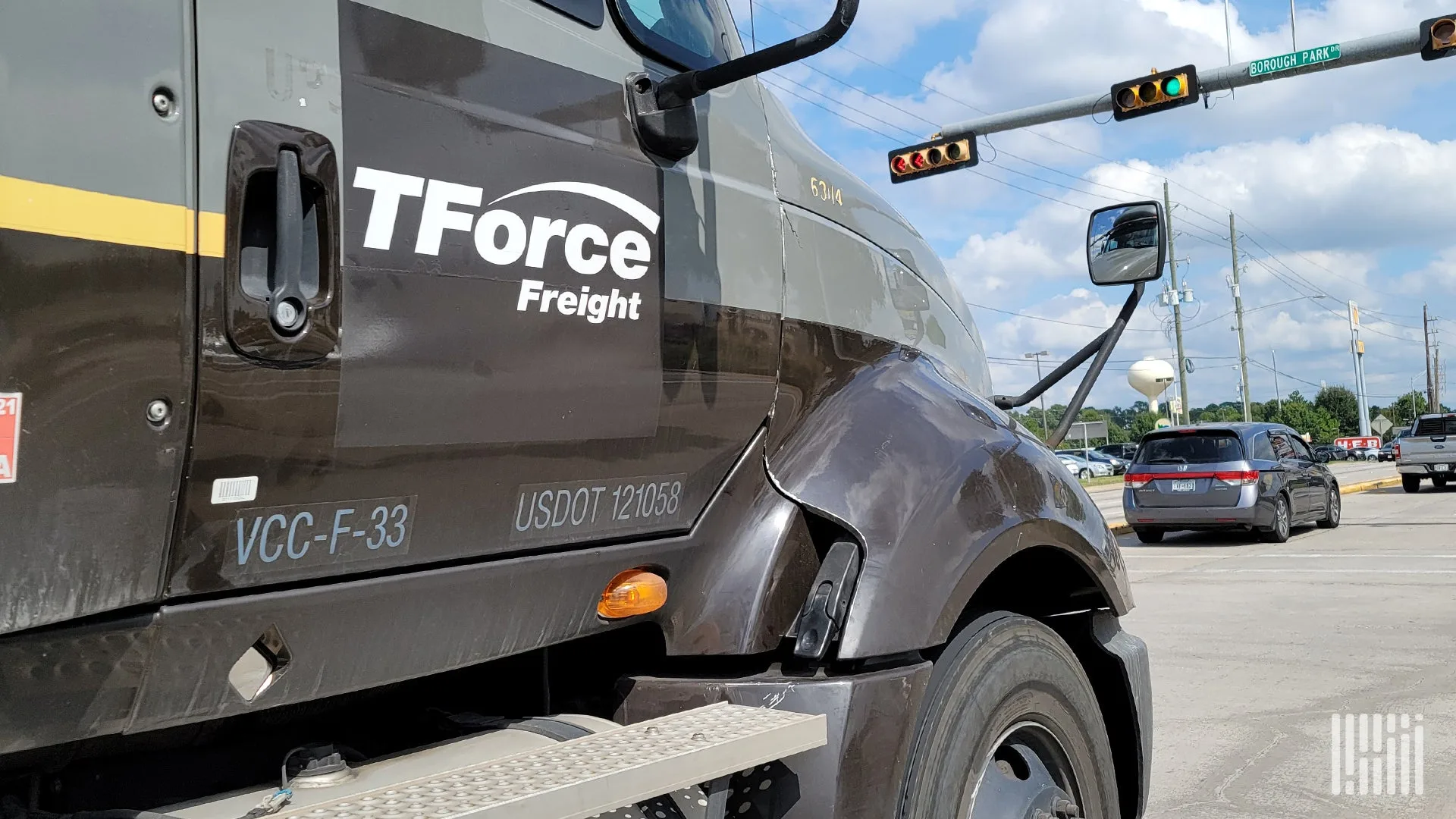
The TFI International fourth quarter 2025 earnings call took place in the middle of the first quarter of 2026, but the company’s two management representatives on the forum made it clear that the first three months of the year have not been going well for the trucking conglomerate.
After posting adjusted earnings per share of $1.09 in the first quarter, which topped the 80 to 90 cents that TFI had projected for 4Q on its third quarter earnings call, TFI said it expected its adjusted first quarter earnings to be 50 cents to 60 cents per share.
“This is down year over year versus 2025, because we’re still in a transition environment,” CEO Alain Bedard said on the conference call. TFI had adjusted net income in the first quarter of 2025 of 76 cts/share.
David Saperstein, TFI’s CFO, said the decline would be created in part because of about a 250 basis point decline in the company’s U.S. LTL operations, which has been the focus of attempted improvement at TFI for several years. But Saperstein added that a first quarter decline in general was not unusual.
“Quarter one is unique in the year in that it’s very back end-weighted to March, so it’s very difficult to get a sense for the trends based on January and the first half of February,” Saperstein said.
Hard hit by weather
But the natural decline has been exacerbated by weather. Saperstein said TFI has probably lost about 100 basis points of U.S. LTL margin because of the weather and its impact on both revenue and costs. For example, Saperstein said overtime expenses have risen this quarter for weather-related issues.
“We’re estimating that we’ve lost like $5 million to $6 million already on the weather,” just through extra overtime and inefficiencies and cleaning up the dock and all that cost,” Saperstein said .
He said January was “very, very difficult, both from a volume perspective and from a cost perspective. But LTL volumes improved in February, he added, and it may turn out that first quarter 2026 volumes are flat to the numbers from 2025,” he added. “We’ll see how the pricing follows as it relates to that, but we can see that the volumes are up.”
Stock market reaction to the earnings Wednesday was relatively muted. TFI stock (NYSE: TFII) closed down 93 cents, or 1.49% to $61.67. The S&P 500 was up 0.56% for the day.
TFI’s stock is down 15.3% in the last year and 10.55% in just the last month, the latter number driven in part by the general logistics and trucking selloff that occured last week.
For the last three months, TFI is up 21.18%, per Barchart data.
What’s up in specialty truckload
While most TFI earnings calls focus on LTL and in particular the company’s U.S. LTL segment, its truckload operations were a topic of more discussion than usual.
The call featured significant focus on TFI’s specialty truckload segment, a business that includes the flatbed operations acquired by TFI when it purchased Daseke in late 2023.
In the company’s slide presentation released in conjunction with the call, TFI said the specialized truckload operations are 35% of the company’s total revenue. What it described as “conventional” truckload is only 4% of total revenue.
Bedard said an OR of 93% for the company’s truckload segment, which is what it reported in the fourth quarter, is “not acceptable, absolutely not.” But he also blamed that on “market conditions.”
Bedard said TFI is “not a van carrier that moves retail freight for a Walmart or Amazon. We move steel, we move aluminum, we move building materials. That’s our core.”
The CEO said he wants to see that group begin targeting freight business tied to the construction of data centers.
For example, Bedard said TFI is working with Bechtel on the construction of a data center. TFI also made a small acquisition late last year–the name of the company was not identified and could not be found in any TFI SEC filings–that is giving TFI an entree into other projects.
“What we’re trying to do is build some kind of a recipe partnering with the builder of those centers,” Bedard said. “And then once this data center has been completely built, they will need servicing, right? So that’s also something that we’re trying to get into and to grow that business.”
Bedard ticked off a list of several areas of growth for specialty truckload beyond data centers, including energy in general and wind and solar in particular.
Bedard also said wind–which has been targeted for rollback by the Trump administration–will be “quite active in ’26.”
As far as the outlook for existing specialty truckload operations tied to industrial activity, Berard said “hopefully that starts to move.”
Difference in drivers
Asked about government crackdowns on non-English speaking and non-domicile CDL holders, Bedard said the specialty truckload sector was protected from that in part by the demands of the job. “On a flatbed or on a tanker operations, there’s more than just driving the truck,” Bedard said. “Whereas the van, you just pick up a trailer and you drive it. So it’s much easier than to tarp a load on a flatbed.”
But Bedard said he could see the driver enforcement cascading down into more specialized types of driving. “Once the spot market moves on the van, it starts to move on the reefer, and we see also some movement on the price on the flatbed side year-over-year,” he said. “So I don’t know is it because the supply is constrained or is it the demand that’s more?”
The largest part of the business, TFI’s LTL operations, continued to struggle in the U.S. in the quarter, but with some areas of improvement.
Bedard was asked if the company had made enough changes in its LTL operations and management that it would be able to capitalize on a turn in the market.
“We are very well equipped,” he said, speaking first of an integration of financial data into a wider portion of the company’s daily operations. That software–Optym–has been implemented for incoming freight into the TFI system. Phase 2, Bedard said, will implement Optym for pickups.
“So we’re ready,” Bedard said. “We have the tools. We are improving our team on the commercial side. We have way more stability in our sales force than ever.”
Cash is king
Bedard in the first minutes of the call turned his attention to TFI’s generation of free cash flow.
“You’ve heard me emphasize many times (we are) producing strong free cash flow regardless of the cycle,” Bedard said. “At TFI, we view this free cash flow as very important given our strong track record of strategic capital allocation. We intelligently invest for the long term, even during down markets, and whenever possible, return our excess capital to shareholders.”
TFI generated $258.9 million in free cash flow in the fourth quarter, up from $207.5 million a year earlier. For the year, the figure was $832.3 million, up from $768.6 million a year earlier.
For a company with so many trucks on the road, it is notable that a slide in the company’s presentation referred to TFI as an “asset-light model.” That description was in conjunction with its capital spending, which showed capex as a percent of revenues at 1.8%, compared to 6.2% of a group of truckload peers and 9.9% for a group of LTL peers. Tighter capital spending produces larger free cash flow.
The TFI data for its comparison was for the trailing 12 months through the fourth quarter of 2025, while the peer groups’ data is through the third quarter.
More articles by John Kingston
International Roadcheck 2026: ELDs under scrutiny
The high-stakes fight over New York City’s renewed delivery regulation law
New territory: RXO debt rating from Moody’s now below investment-grade cutoff
The post TFI already seeing a tough set of first quarter numbers appeared first on FreightWaves.