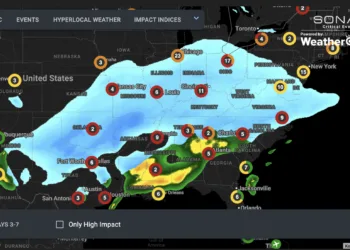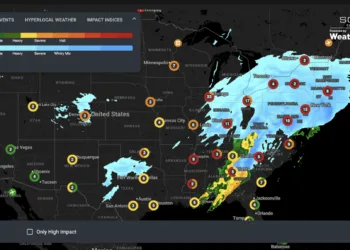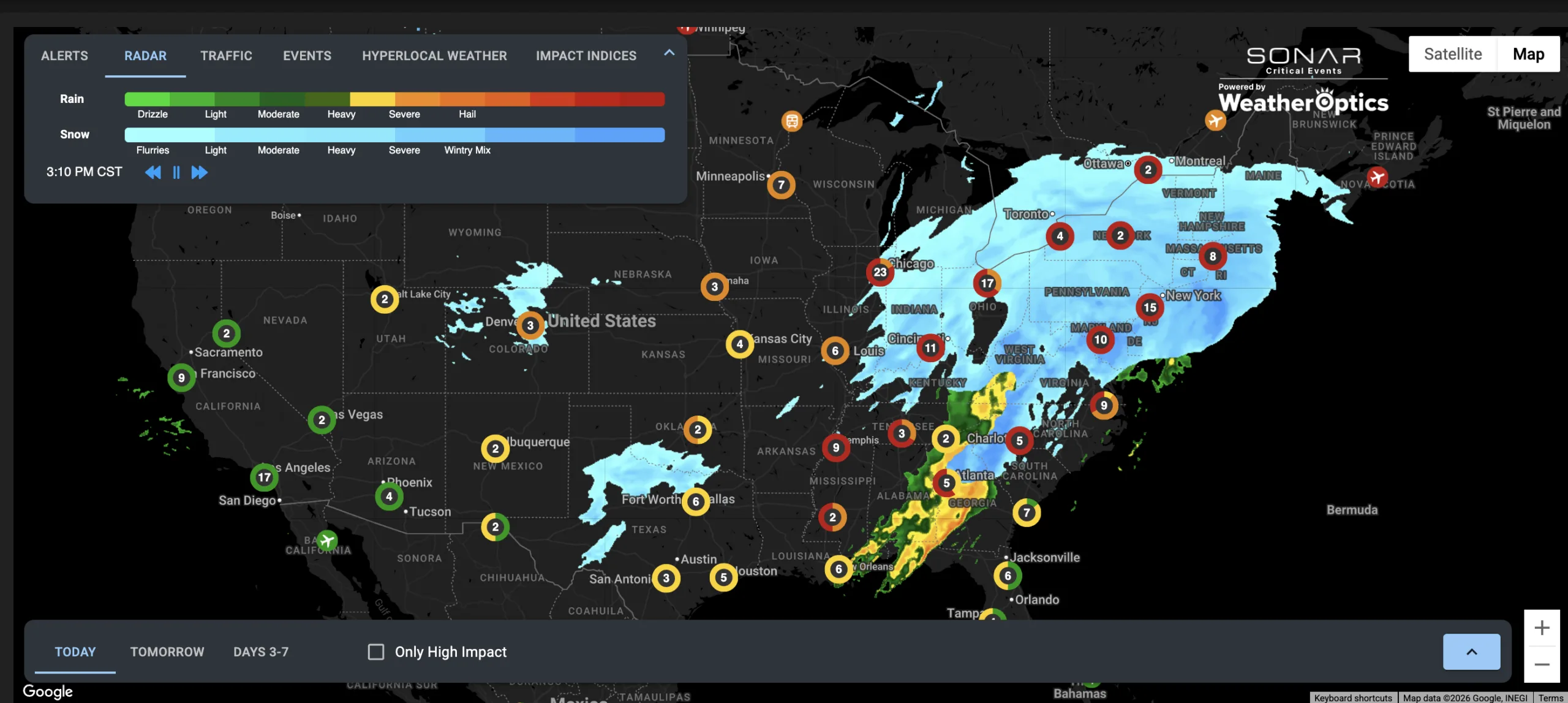
Winter Storm Fern has battered the Southeast and Lower Midwest and is set to finish its sweep through the Northeast by the end of the day. According to ABC News, snowfall totals have topped 8” in Arkansas, 11” in Illinois and Ohio, 13” in Indiana, 8” in Kansas, 12” in Missouri, 7” in Oklahoma, 6” in Texas and 5” in Tennessee. Ice storm warnings remain in effect from Texas through Tennessee and Georgia and into the Carolinas.
At the time of publication, the storm is expected to deliver snowfall rates of up to one inch per hour along the I-95 corridor in the Northeast Sunday afternoon and into the evening. Major airports have already grounded flights, with more than 14,000 cancellations tied to the storm. John F. Kennedy International, LaGuardia and Newark Liberty airports in the New York City area are closed, along with Ronald Reagan Washington National Airport, Baltimore/Washington International Thurgood Marshall Airport and Philadelphia International Airport.
Atlanta, Charlotte and Dallas-Fort Worth remain operational but are experiencing significant delays and are on standby for potential ground stops.
Port terminals in New York and New Jersey are closed and will remain shuttered as the storm moves through the region. Major freight hubs in Louisville, Cincinnati and Memphis are also seeing disruptions, prompting customers to closely monitor tracking information for the most accurate updates.
While the Northeast braces for heavy snowfall, Winter Storm Fern is winding down in the Southeast, where more than one million people remain without power at the time of publication. ABC News reports that Tennessee, Mississippi, Louisiana, Georgia and Texas have been hit the hardest and are experiencing the highest number of outages.
Amtrak has postponed operations through Monday. BNSF, CSX and Norfolk Southern have also activated winter action plans. According to Reuters, “BNSF warned customers moving freight through storm-affected regions to expect delays and longer transit times, and said shipments may temporarily take nonstandard routings, pass through unfamiliar locations or experience atypical interchanges during the disruption.”
The most challenging phase of the storm may come after the snow and ice stop falling. In an interview with FreightWaves, DTN General Manager of Weather and Climate Intelligence Renny Vandewege explained why delays could linger longer than usual across the South. “There are not as many resources for post-storm cleanup in the Southeast,” Vandewege said. “It will be somewhat up to nature to help with the cleanup. What resources are available will be prioritized for high-traffic areas like interstates and then state highways. The fastest way to clear ice and snow is for temperatures to rise above freezing, which unfortunately may take some time. The cold will stick around for a few days following the storm.”
Historically, winter storms in the Southeast are short-lived, with temperatures warming quickly and allowing conditions to improve. This time, however, a lingering cold could prolong disruptions. “The biggest impacts will come from melting ice and snow during the day, followed by below-freezing temperatures at night,” Vandewege said. “That’s when refreezing and black ice become significant issues.”
With widespread power outages across the region, recovery from Winter Storm Fern is unlikely to be limited to a day or two of delayed shipments. In some areas, it could take weeks for operations to fully return online.
Vandewege emphasized the importance of contingency planning, noting that many carriers and shippers have already taken proactive steps. “Our best practice is to set standard operating procedures based on the forecast,” he said. “Better safe than sorry, depending on your ability to handle incoming weather.” Even modest snowfall can have outsized impacts in the Southeast, where two inches of snow presents a far different challenge than it would in the Northeast.
The post Southeast power outages: Winter Storm Fern’s impact appeared first on FreightWaves.