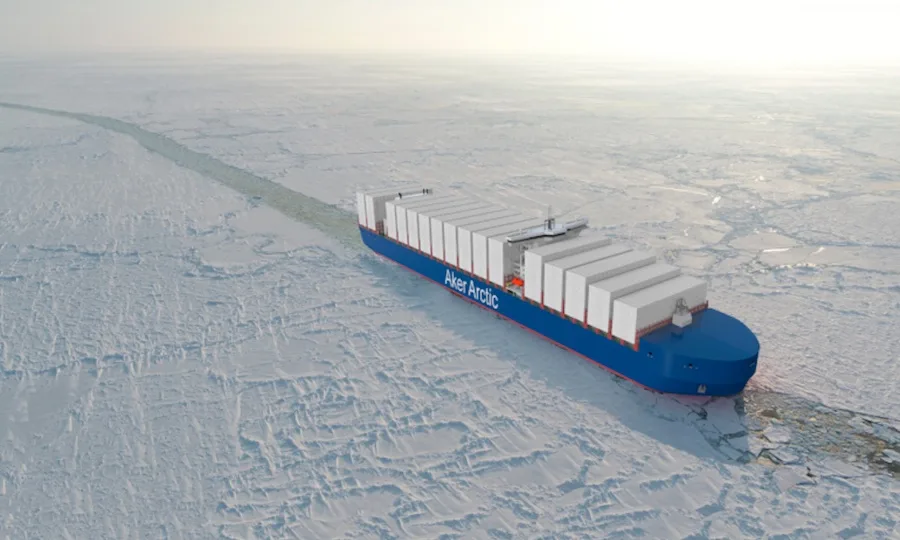
South Korea has formally elevated Arctic shipping into national policy, with Seoul planning its first-ever container ship trial voyage via the Northern Sea Route later this year.
The Ministry of Oceans and Fisheries (MOF) confirmed it is preparing a September trial using a 3,000 teu-class containership sailing from Busan to Rotterdam, marking the country’s first container transit of the Arctic corridor. The Arctic route has been designated a flagship policy initiative under the administration of president Lee Jae-myung, signalling a more strategic push by Asia’s third-largest economy into polar trade lanes.
Speaking at the ministry’s first press briefing at its Busan headquarters this month, acting oceans minister Kim Seong-beom said timing was crucial. “In the Arctic route region, September is considered summer when there is the least ice,” Kim said, adding: “We plan to prepare for trial voyages around that time.”
If successful, the route could significantly shorten Asia-Europe transit times. The traditional Suez Canal route stretches roughly 20,000 km and typically takes around 30 days. The Arctic alternative cuts the distance to about 13,000 km, reducing sailing time to around 20 days.
South Korea has already tested the Arctic in limited form, having operated bulk carriers on five voyages between Busan and Russia’s Yamal Peninsula. However, it has never deployed a containership on the route. China moved ahead last year, opening what it described as the world’s first regular Arctic container service.
Geopolitics loom large over Seoul’s Arctic ambitions. Much of the Northern Sea Route runs through Russian territorial waters or its exclusive economic zone, making Moscow’s cooperation unavoidable. At the same time, South Korea remains aligned with US and European sanctions on Russia.
Kim acknowledged the delicate balance required. “Russia requires permission for passage through Arctic route waters, so cooperation with the country is crucial,” he said. “However, since South Korea is also participating in Western countries’ sanctions against Russia, we will find a way to address both issues.” He added that consultations with Russian authorities are planned within the first half of the year.
Commercial viability is another major hurdle. Arctic operations typically attract higher insurance premiums, especially north of 60 degrees latitude. A previous MOF study estimated that operating a 5,000 teu-class vessel on the route would incur additional costs of about $435,000 per voyage.
“We will discuss incentives for shippers participating in the trial voyage with shipping companies,” Kim said. “Once economies of scale are achieved through route usage, profitability will align, but some incentives are inevitable before that.”