With its end-2025 acquisition trifecta that brought it three factoring companies all at once, Love’s Travel Stops is likely to look for more this year to grow its factoring activities within its Love’s Financial Services division.
Love’s announced the acquisition of three factoring companies–TBS Factoring Service, Saint John Capital and Financial Carrier Services–just before Christmas. The price was not disclosed, nor the sellers, but various references elsewhere suggested the companies were interlinked in different ways.
“I think the acquisitions really speak to our commitment to growing this business and supporting the industry,” Love’s President Wharton said during the call.
In what has become an annual event to review the company’s plans for the coming year, Wharton told an online forum with various media that factoring consolidation, widely discussed in the industry, has a basis in reality.
“There have been a lot of smaller players that have run into some challenges and so there are some possible rollup opportunities,” Wharton said. He described the three-company acquisition as “a good-sized purchase.”
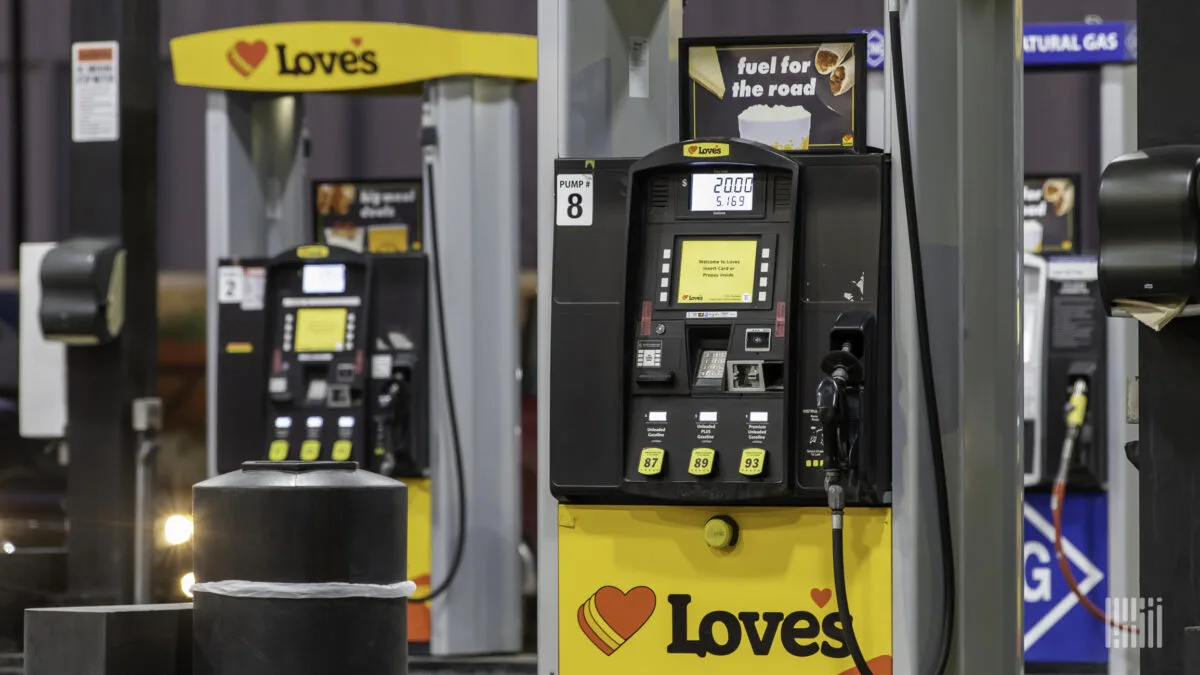
Love’s is unique in the truck factoring sector because most factors consist of an office and communication tools, backed by financing. Love’s is in the face of its potential customers with its network of 668 travel centers (a number confirmed by a Love’s representative on the conference call).
“A lot of our competitors, all they offer are factoring services or they may offer a fuel discount,” Wharton said. But those companies are not “the entity that’s actually providing that fuel. So yes, it gives us the ability to bundle different products and services together, and I think that’s attractive to a lot of customers. They trust and know a lot of our other products and services.”
Pipeline empty for now
“I think there are still opportunities out there,” Wharton said, though he added that “we don’t have something in the pipeline at this second.”
“We feel we have a really good value proposition for our customers, and we want more customers to experience that,” Wharton said.
Wharton’s annual call with the media ranges widely, with discussions as diverse as growth in electric vehicle chargers to new types of foods in the various restaurants that can be found through the Love’s network.
Renewable diesel plant opening
But a big moment for a very different business for Love’s this coming year will be the opening of Heartwell Renewables, which will produce 80 million gallons of renewable diesel annually
That is a relatively small plant; by contrast, the Phillips 66 Rodeo, California renewable diesel facility in the San Francisco Bay area produces 800 million gallons per year.
Wharton said Heartwell, which is in Hastings, Nebraska, is expected to open later this year though a precise or approximate date was not disclosed
“This is a huge, gigantic project, and we’re excited to get it open,” Wharton said. The workforce there will be about 70 employees, he added.
The investment by Love’s in Heartwell is an example of a company going upstream in its particular area of business. Love’s, among other activities, sells a lot of fuel, diesel in particular. It is going upstream to help secure a supply of that fuel, in this case, renewable diesel which is a “drop-in” fuel that is chemically identical to diesel that comes from a petroleum refinery.
That sort of reverse integration has always been controversial in numerous industries. In the petroleum industry, several fully integrated companies in recent years split into an upstream division that produced hydrocarbons from the ground, and a separate company that refined them. ConocoPhillips spun off its refining operations into Phillips 66; Marathon Oil split into Marathon Oil (upstream) and Marathon Petroleum (downstream). ExxonMobil and Chevron have stayed as fully integrated oil companies.
The decision at Love’s to take that upstream step, Wharton said, “comes from a couple of places. One is to generally support this industry. We’re in the business of providing fuel to our customers, and renewables is part of that fuel.”
Although Wharton did not mention it, the production of renewable diesel generates Renewable Identification Numbers (RINs), which can be sold to companies that need to acquire them to meet their respective requirements under the Renewable Fuels Act. Fuel retailers like Love’s generally do not have an renewable fuels mandate, so all of the RINs generated by Heartwell can likely be sold to companies that do.
RINs economics are a key factor in determining the economic viability of a renewable diesel project. One of the reasons why so many RD projects are in the West Coast is the sale of the product can generate not only RINs but also credits under California and Oregon’s Low Carbon Fuel Standard.
Wharton said Love’s believed Heartwell as a good investment, “and we felt like and we still feel like we have expertise in the space. You put all those things together and we decided to go forward.”
Love’s will market all the offtake from the plant. But Wharton added that “obviously a lot of that’s going to end up in Love’s facilities.”
Wharton said most of the feedstock for the plant will be tallow, which is an animal fat.
New stores, more parking
Addressing Love’s core business, Wharton said the company this year plans on opening 20 new locations. When asked where they would be located, he said “across all parts of the country.”
Capital expenditures to invest in the Love’s network will total $700 million, an amount that will include not only new stores but remodeling of others. The total work, Wharton said, will be 55 locations “that will either be new or refreshed.”
The projects, whether they are new stores or remodeled facilities, will add about 1,500 parking spots to the Love’s network of almost 51,000 spots, Wharton said new parking in 2025 totaled about 1,400 spots, he added.
One shift in policy during remodeling is that more of the store undergoing renovation will be fully closed. “We found over the last year or two that doing these remodels while open was not a good experience for our customers,” Wharton said. “In a lot of cases we can get them done faster if we actually close down the location.”
During a closure, the Love’s facility will still provide fuel, restrooms and some food and drink options, many of them through an onsite trailer, Wharton said.
While 2025 might have been a big year at Love’s in its expansion in its network of travel centers and its factoring business, there was another huge development for the company: its sponsorship of the hometown Oklahoma City Thunder which won the NBA championship, led by NBA most valuable player Shai Gilgeous-Alexander.

Love’s logo is prominent on the Thunder’s uniform, more visible than many team logos found on other NBA jerseys.
“The marketing team has consultants that do an analysis and look at the reach and how many times the logo has been seen,” Wharton said. “The value is pretty strong if you look at it compared to if you paid for all that media.”
But there are other values, Wharton said. “It also helps in terms of recruiting talent to the team here in Oklahoma City, “ Wharton said, citing in particular several new executives who have joined the company in the past year in key roles, all of whom came from outside OKC.
“It definitely helps put a positive halo over the city,” Wharton said of the NBA title holders.
More articles by John Kingston
Werner settlement ready to go in drivers’ lawsuit that dates to 2014
Amazon’s LTL offering reaching out to shippers as possible customers: report
NFI’s Brown, others win another round in dismissed New Jersey indictment
The post No new deals imminent, but Love’s eyeing more growth in factoring appeared first on FreightWaves.