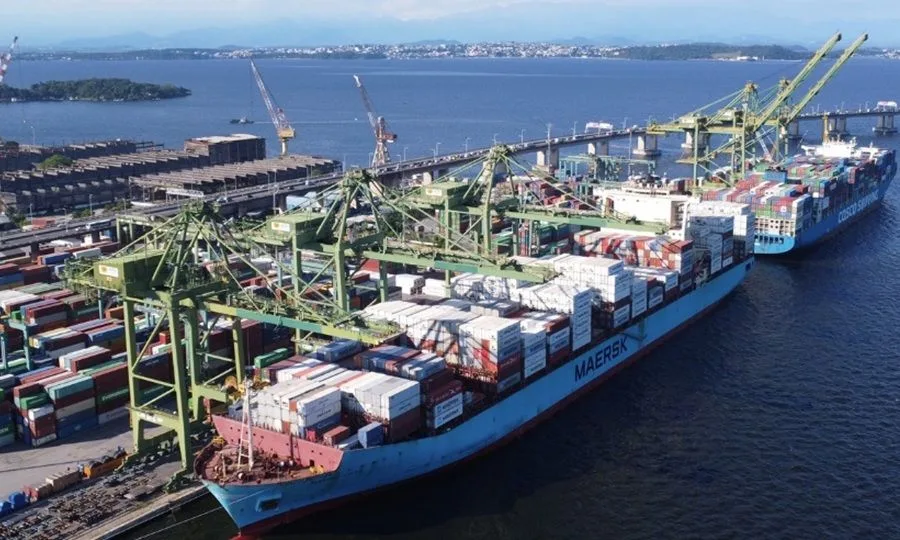
Manila-based port operator International Container Terminal Services Inc (ICTSI) is pressing ahead with a major expansion at Brazil’s Rio Brasil Terminal, committing R$948m ($175m) to lift capacity and modernise operations at the Port of Rio de Janeiro.
The investment programme, running from 2025 to 2029, will increase annual capacity by more than 70%, from 440,000 teu to 750,000 teu, positioning the terminal as a key logistics gateway for Brazil’s Southeast and Midwest regions.
Brazil’s minister of ports and airports, Silvio Costa Filho, said the project underlines the government’s focus on private investment to strengthen the country’s port system. Of the total spend, around R$414m will go into infrastructure works, with a further R$533m earmarked for new equipment.
Planned upgrades include expanded and unified container yards, redesigned internal layouts to improve cargo flows, new ship-to-shore and yard equipment, and modernised electrical and utility systems. ICTSI will also roll out new automation, access control and cargo management systems, while upgrading facilities to meet Brazilian customs requirements.
Costa Filho said the expansion could eventually take capacity beyond 1.2m teu, adding that the project would also support job creation and income generation in the region.
From an operational standpoint, the upgraded terminal will be able to handle new panamax and post-panamax vessels, including ships up to 366 m and more than 13,000 teu. The first two new cranes are due to arrive by mid-2026 and are designed to work vessels of up to 400 m in length.
ICTSI Rio Brasil Terminal chief executive Roberto Lopes said the expansion will help relieve pressure on Santos, Brazil’s busiest port, by redistributing container flows. He added that the project builds on ICTSI’s wider logistics investments in Brazil, including more than R$190m already spent on the Rio-Minas and Rio-Suzano corridors, with a focus on rail connections.
With additional cranes and yard space coming online from 2026, ICTSI is already marketing the extra capacity. Full implementation is expected to see utilisation settle at around 75% by 2029–2030, improving predictability, reducing waiting times and lowering logistics costs. ICTSI vice-president for the Americas Anders Kjeldsen said the project reflects the group’s long-term commitment to Brazil. ICTSI operates 34 terminals in 20 countries.