With a second administration under Donald Trump now a guarantee, much talk has been devoted to tariffs and the economic harm they threaten to inflict on the U.S.
But in “A User’s Guide to Restructuring the Global Trading System,” Stephan Miran makes a compelling case that — contrary to popular belief — tariffs can achieve a multitude of aims without causing inflation or market volatility.
The downside? The path to effective tariff implementation is narrow and difficult to travel, with many risks and contingencies involved.
What follows is only a brief overview of the paper and its arguments, which can (and should) be read in its entirety here.
The weight of the world
Miran begins his case by stating that the U.S. dollar is heavily and consistently overvalued because “dollar assets function as the world’s reserve currency.” When the U.S. dollar is strong relative to other currencies, imports become cheaper but domestic manufacturing suffers greatly.
The weakening of domestic manufacturing has several knock-on effects that add to a general feeling of economic discontent among many Americans — this discontent was, in large part, responsible for the re-election of Trump. Local economies, once dependent on manufacturing jobs, wither and become increasingly dependent on federal aid and/or narcotics to cope with the barrenness of their new reality.
Yet, while this issue of overvaluation could be easily solved by dissuading the dollar’s use as the global reserve currency, Trump and his policymakers are firmly against such a solution.
Maintaining the U.S.’ status as reserve currency holder entitles it to several privileges, not least of which is the ability to “exert its will in foreign and security policy using financial force” rather than directly through military operations. Case in point: U.S. sanctions against Iran under Trump effectively crippled Iran’s economy, triggering a recession in which food costs surged 61% over a single year.
Holding both the world’s reserve currency and a powerful military force — the carrot and the stick, as it were — the U.S. can project power unlike any other country. But this ability comes at a cost that is borne by working-class citizens.
So, is there a way for the U.S. to maintain its global preeminence while easing the economic burden of average Americans?
Enter the tariff
In its simplest form, a tariff is a tax on imports, whether targeting imports from a single country or a blanket tariff applied to all imports. Tariffs raise revenue for the U.S. Treasury, just as any tax does.
The fear is that tariffs are inflationary because they increase the price of consumer imports. Yet recent history suggests a different outcome: During the 2018-19 trade war with China, the U.S. dollar strengthened against China’s currency almost at the same rate that tariffs did, counterbalancing any significant rise in U.S. goods inflation.
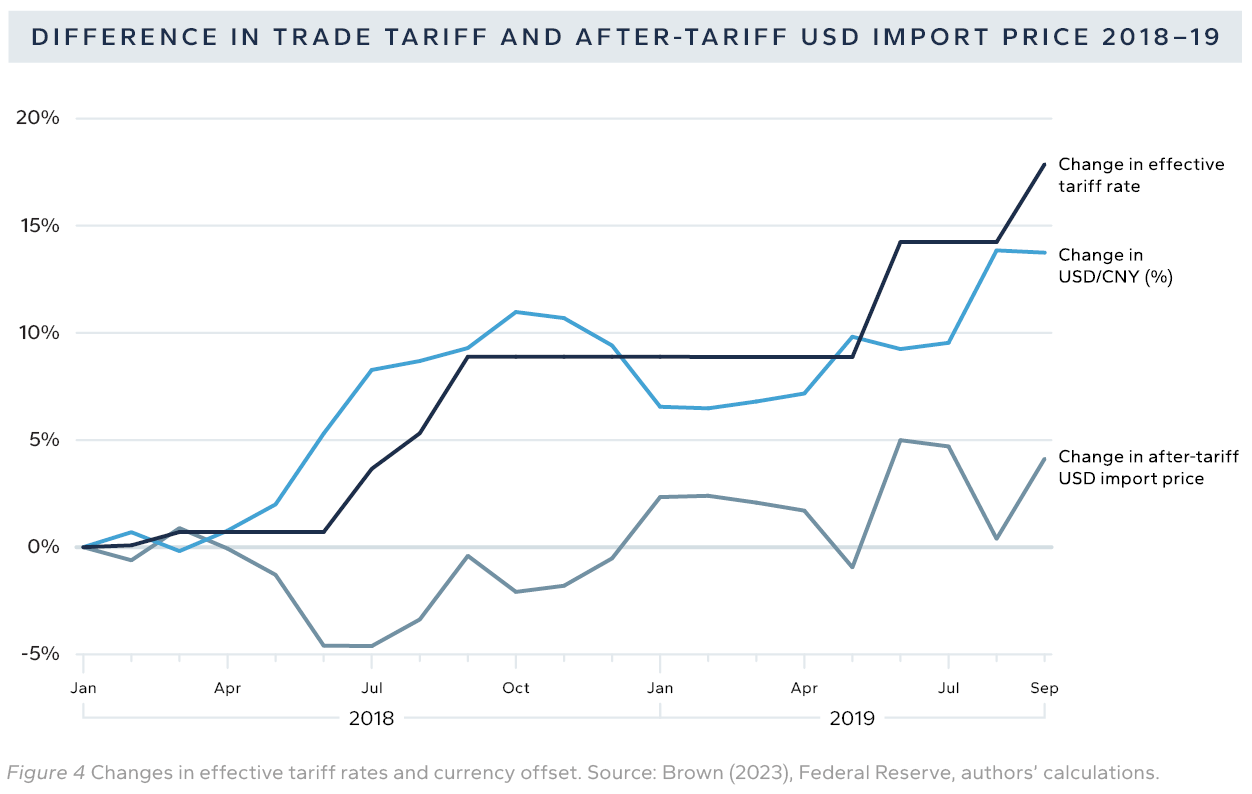
This relationship between tariff rates and exchange rates is something Miran calls “currency offset” — a concept necessary to understand how tariffs work in practice.
A tariff is one way for the government to put its thumb on a scale, moving a trade deficit with a country towards balance. As trade between, say, the U.S. and China moves from deficit to balance, demand for U.S. goods — and thus the dollar — rises in China.
In other words, the U.S. dollar is strengthened by tariffs against the currency held by the target country. A stronger dollar gives Americans more purchasing power for imports from the target country.
Perfect currency offset is achieved when the dollar strengthens in exact proportion to the tariff rate, thus not impacting U.S. consumer prices whatsoever.
What tariffs against China do impact, however, is the purchasing power of Chinese citizens: With a weaker currency, Chinese consumers are made poorer. It is in this respect that China can be said to “pay for” the tariffs.
Note that this explanation describes “perfect” currency offset, which rarely occurs in an imperfect and messy world. Miran details a few obstacles to currency offset in the upcoming wave of tariffs, though he concludes that “offset seems more likely than not.”
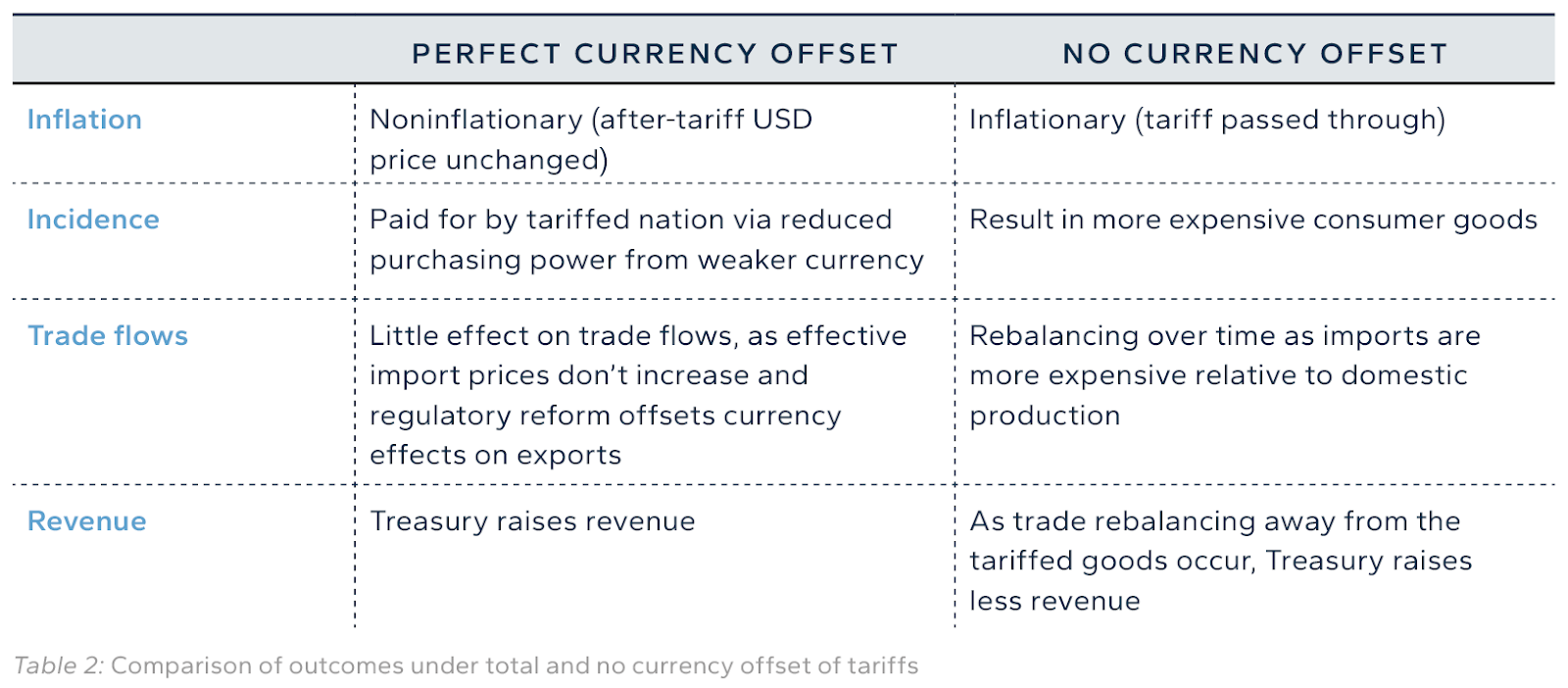
The above table lists the impacts of the two extremes between perfect currency offset and none at all; the real impact is sure to be somewhere in the middle.
Even if no currency offset were to occur (which is extremely unlikely), inflation would only be aggravated in the short term. The medium-to-long-term consequences would be that manufacturing would return to the U.S. or other tariff-exempt countries and that consumers would shift their demand to goods of this provenance. That manufacturing returns to the U.S. and not other countries depends on the incentives offered, a discussion beyond the scope of this article.
Trade war — what is it good for?
On their own, tariffs are a crude instrument, but they can be skillfully used for subtle ends.
In his first administration, Trump wielded tariffs against China as a negotiating tactic. These negotiations ultimately yielded the “Phase One” trade agreement in January 2020, which included promises from China that it would not manipulate its currency and would refrain from intellectual property theft.
Unfortunately, China did not commit to any of the purchases promised under this agreement, in part because there was a global pandemic and ensuing recession soon after. If similar agreements were sought in the future, Marin argues, the U.S. should secure them by measures like “placing [China’s] U.S. Treasury reserves in escrow.”
The bigger picture here is of blanket tariffs which, like any other tax, may include certain exemptions. It is these exemptions, and not the tariffs themselves, that are the real tool.
Miran imagines a list of criteria that could lessen or increase the tariffs applied on a given country, all of which are “premised on the notion that access to the U.S. consumer market is a privilege that must be earned, not a right.”
Such a use of tariffs would be a win-win for the U.S. If a country offers more favorable trading conditions to the U.S., if it relies less on the U.S. for its own defense spending, if it sides with the U.S. in international disputes, etc., it would increase the standing of the U.S. and (in many instances) enrich the average American by stimulating the domestic manufacture of goods.
On the other hand, if it opts to bear the brunt of tariffs head-on, that money goes to the Treasury as an alternative means of taxation — one that U.S. citizens do not have to pay, and one which does not majorly affect consumer prices here.
Simply put, it’s a win-win because the U.S. and its citizens get paid either way.
I once again urge the reader to study the full text of Miran’s paper: The writing is clear and the arguments well-formed, with much further detail and consideration of risks or objections than this overview can allow.
The post How I learned to stop worrying and love the tariff appeared first on FreightWaves.