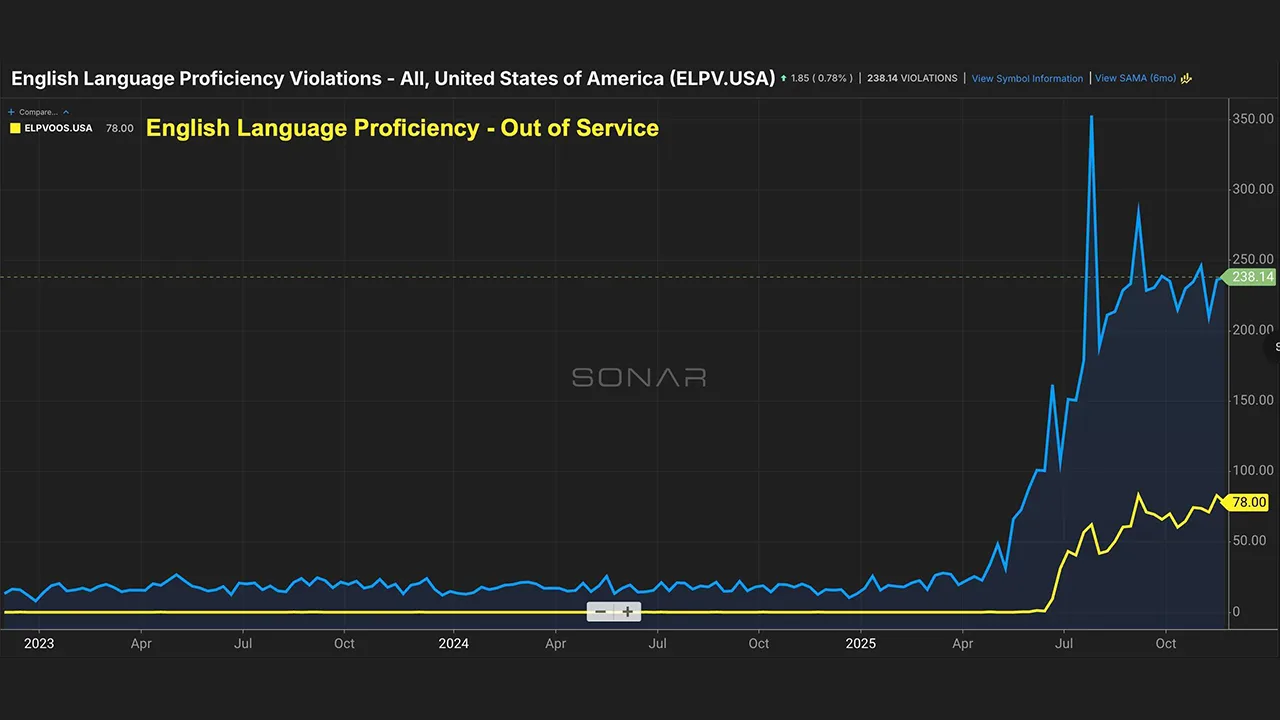
Through October 2025, federal motor carrier safety inspectors have issued 6,455 English language proficiency (ELP) violations while placing only 1,816 drivers out of service for the same infractions, creating a notable enforcement gap that industry experts say reflects legitimate regulatory exemptions rather than inconsistent enforcement.
The data, compiled by SONAR from DoT and FMCSA records, shows the disparity widened significantly beginning in June 2025 when ELP violations jumped from 1,399 in May to 3,925 in June. Out-of-service orders followed a similar but less pronounced trajectory, rising from 4 in May to 328 in June before peaking at 2,155 in September.
The dramatic increase in ELP enforcement activity marks a sharp reversal from nearly a decade of what amounted to a regulatory timeout. A 2015 memorandum issued during the Obama administration effectively pulled the plug on active enforcement of English language proficiency requirements, directing inspectors to back off applying the regulation. The memo remained operational policy through multiple administrations, creating what many in the industry saw as a wink-and-nod approach to ELP compliance at roadside inspections.
That changed quickly in early 2025 when a new executive order flipped the switch back on and directed the FMCSA to resume full enforcement operations. The Commercial Vehicle Safety Alliance followed up by updating its out-of-service criteria to provide inspectors with clear guardrails for determining when a driver’s English proficiency is so poor as to warrant a shutdown. The updated CVSA criteria established specific thresholds for communication capability and standardized how inspectors assess language skills across state and federal inspection programs.
Since the enforcement reboot, the numbers show an industry and an inspection community working through requirements that had technically existed all along but had been gathering dust for a decade. The June 2025 spike aligns directly with when the revised CVSA guidelines took effect and inspectors completed training on properly evaluating ELP at the roadside.
Federal regulations require commercial motor vehicle drivers to read and speak English well enough to communicate with the general public, understand highway signs and signals, respond to official inquiries, and complete reports and records. But here’s where it gets interesting, the regulation contains specific exemptions that explain why a driver might catch a violation without getting benched.
The most significant exemption applies to drivers working within commercial zones along the U.S.-Mexico and U.S.-Canada borders. These zones, defined under 49 CFR 390.5, let drivers with limited English proficiency operate commercially as long as they stay within designated boundaries typically stretching 20 to 25 miles from international crossings. Inspectors in Texas, which racked up 7,090 ELP violations through October, and other border states regularly encounter drivers operating perfectly legal under this exemption.
Hearing-impaired drivers represent another protected group under the Americans with Disabilities Act. These drivers may hold valid CDLs with hearing exemptions issued by FMCSA and can’t be placed out of service just because their disability limits their communication. Instead, inspectors document the violation while letting legally qualified drivers continue down the road.
Other scenarios where violations happen without out-of-service consequences include drivers who demonstrate borderline but acceptable English during inspections, situations where someone shows up to help translate and facilitate communication with enforcement, and cases where drivers have proper exemption paperwork that might not surface immediately when an inspector makes contact.
The geographic spread of ELP enforcement shows heavy concentration in southwestern states. Texas leads the pack with 7,090 violations, followed by New Mexico with 1,112 and Oklahoma with 751. The concentration reflects both border zone operations and major freight corridors funneling loads from Mexico into U.S. distribution networks.
Federal inspections accounted for 15,193 ELP-related enforcement actions through October, representing the lion’s share of activity nationwide. That federal inspection total covers violations documented during Level I through Level VI inspections conducted by multiple agencies operating under FMCSA oversight.
The trend lines through October suggest ELP enforcement activity might be finding its groove after the chaotic ramp-up earlier in the year. Violations dropped from a September peak of 7,140 to 6,455 in October, while out-of-service orders fell from 2,155 to 1,816 during the same stretch. Still, both numbers remain way up compared to the first quarter of 2025 when monthly violations stayed under 800 and out-of-service orders barely registered.
What the pattern really shows is inspectors getting better at separating drivers who legitimately qualify for exemptions from those whose English genuinely creates a safety problem. The declining ratio of violations to out-of-service orders in recent months suggests inspectors are getting more comfortable with exemption categories and more precise in applying CVSA criteria.
Fleets operating near international borders or carrying drivers with documented exemptions need to ensure proper credentials remain within arm’s reach during roadside inspections. Being upfront about exemption status when an inspector walks up can prevent a lot of hassle while they verify everything checks out.
The gap between violation counts and out-of-service orders shows that ELP enforcement, despite waking up from a long nap, still recognizes the legitimate exemptions baked into federal regulations. Carriers and drivers operating under authorized exemptions should expect ongoing documentation checks without automatic shutdowns, provided they remain compliant with applicable geographic or medical qualification limits.
FMCSA hasn’t dropped any new guidance on ELP enforcement protocols for 2026, but current activity levels suggest the renewed focus on language proficiency requirements isn’t going anywhere.
The post FMCSA English Proficiency Violations and Why Carriers Aren’t Being Shut Down appeared first on FreightWaves.