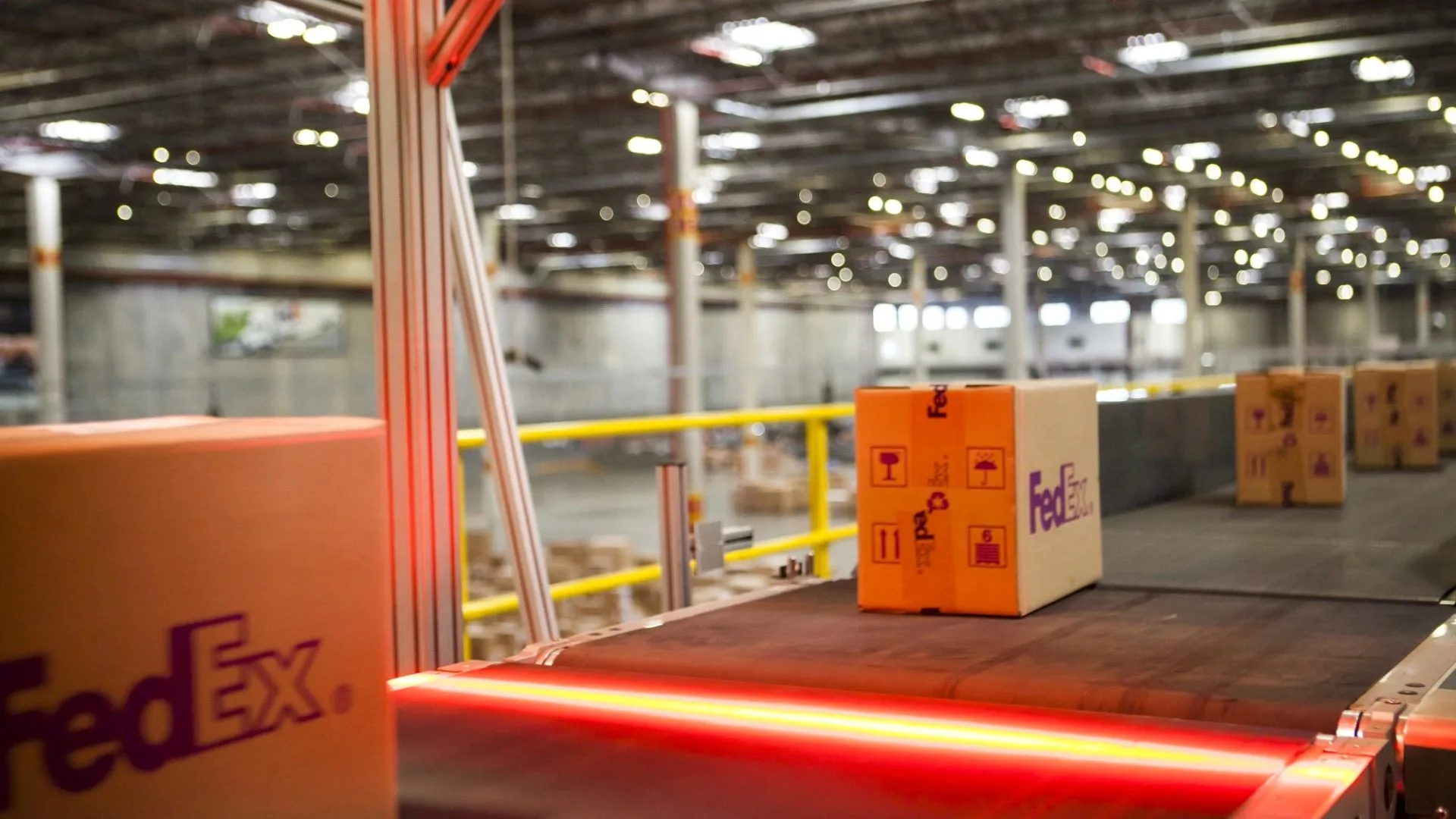
FedEx delivered its bluntest message yet about its approach toward fast fashion and other low-cost parcel shippers at last week’s Investor Day event, doubling down on its shift in recent years toward more high-margin B2B logistics relationships and premium direct-to-consumer shipments.
E-commerce sellers looking for cheap, no-frills home delivery: Goodbye. And B2C retailers with more specialized needs for high-quality shipping and reliability? Be ready to pay a larger premium and lots of surcharges.
“Our strategy is to prioritize the high-value segments where our network provides a distinct advantage — long haul, heavyweight and cross-border e-commerce. Unlike those focused on the last mile, our strength is end-to-end solutions,” Chief Customer Officer Brie Carere told stock analysts and industry stakeholders gathered at the company’s Memphis, Tennessee, headquarters. “If you’re shipping T-shirts, FedEx might not be for you. But if you were shipping Oura rings, FedEx is for you.”
Management’s goal is to profitably grow its 30% share in the $310 billion global market for B2C logistics by low single digits through 2029. The fact that 70% of the ground service revenue comes from shipments traveling over 300 miles, and that half of shipments move more than 600 miles, underscores how the transport and logistics giant is geared differently than the bevy of alternative parcel carriers in local last-mile delivery, said Carere.
For FedEx, specialized B2C business covers small-and-medium enterprises that generally don’t have multiple fulfillment centers and tend to ship across multiple delivery zones, as well as heavyweight and high-value goods. FedEx has a large market share in the heavyweight sector, but also is very competitive with parcels two pounds and above, according to management.
A strong pricing environment has enabled FedEx to increase yields.
Returns business
FedEx sees continuing opportunities in omnichannel reverse logistics, which represents a $500 million total addressable market. One way to add value for retailers is to help them with online returns. A smooth and easy returns process helps convince consumers to complete purchases and builds brand loyalty.
The company recently launched new post-purchase digital tools in collaboration with parcelLab that helps retailers simplify the returns process. When combined with FedEx’s no-box, labelless returns options and convenient store drop-off locations, the platform provides consumers a simplified experience. The AI-powered tools automate customer support for common delivery and returns questions, and search for patterns and anomalies across tracking and returns data to help shippers identify problems and opportunities.
“We love a return as it shows up in our network as a profitable B2B move,” allowing the carrier to build route density back to a retailer’s distribution center, the revenue chief said.
Surcharges
Carere made clear that FedEx will no longer subsidize e-commerce shipments simply to lower operating cost through better density. Instead, retailers must pay for the true value of FedEx’s infrastructure investments and premium service. Surcharges, she said, are a key part of the revenue strategy and will increasingly be exported to the company’s international operations.
“To make money in e-commerce, you have to account for the incremental cost,” Carere said. FedEx, for example, should be properly compensated for leasing extra equipment, adding part-time workers and utilizing more commercial partners during the busy holiday season to make sure retailers get merchandise to stores and customers’ homes without experiencing delays from the surge in demand.
“Peak surcharges are a win-win. It’ll let them sell at Christmas and it allows us to bring on the resources profitably to do that,” FedEx’s top sales executive said.
Major parcel carriers have applied peak-season surcharges for many years, but some industry watchers have questioned the pricing strategy as a revenue grab at a time when volume growth during recent peak seasons has slowed and companies rationalize their networks for better efficiency.
Extra fees for parcel shipping were the main contributor to higher-than-expected rates during the fourth quarter last year and rates are expected to rise again in 2026, according to AFS Logistics and TD Cowen investment bank. Their report pointed out how FedEx and UPS introduced a blanket demand surcharge for residential delivery despite forecasts for muted growth. The blanket policy represents a major shift from previous demand charges that more precisely targeted delivery costs like volume surges, large packages and additional handling requirements.
FedEx also applies surcharges to large, heavy, hard-to-handle deliveries over 50 pounds, which are very profitable packages, according to the company. Under a 2025 agreement, FedEx is delivering large packages for Amazon to certain areas.
Analysts say the widespread use of add-on fees risks driving retailers to cheaper, alternative carriers. Rather than seeing that as a problem, FedEx is actively conceding lightweight, low-margin parcel shipments to competitors.
“The most important structural change is that we are really adjusting our pricing strategy to cover all costs to make sure that we’re getting paid for our differentiation. And what’s exciting is what we’ve learned here in the United States, we’re taking to Europe. We’ve taken to Asia. We no longer constrain ourselves to just peak surcharges at Christmas. We have to adjust when we’ve got capacity,” Carere said.
Click here for more FreightWaves/American Shipper stories by Eric Kulisch.
Write to Eric Kulisch at [email protected].
RELATED STORIES:
FedEx offers lower cost no-box, no-label returns
FedEx group to buy InPost for European out-of-home parcel network
FedEx preparing major sort center expansion at Memphis air hub
The post FedEx doubles down on premium e-commerce, delivery surcharges appeared first on FreightWaves.