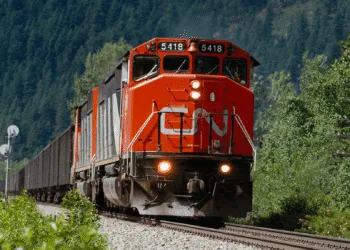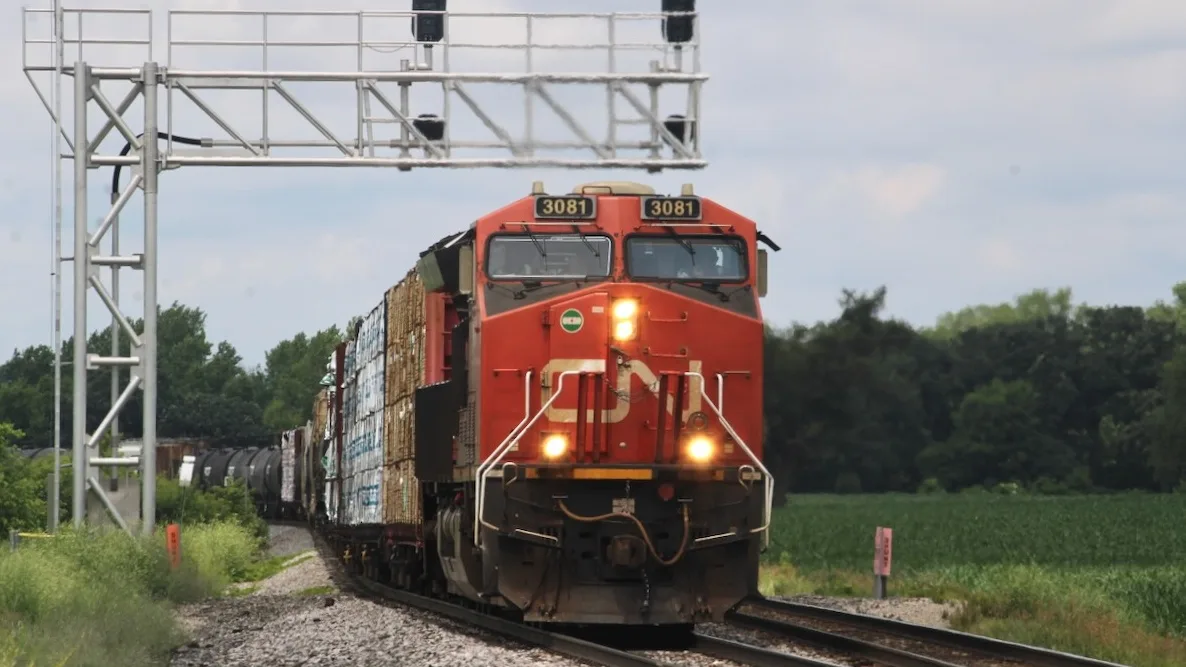
Canadian National showed gains in traffic, revenue, and operating income in the fourth quarter of 2025, the company announced ahead of market openings Thursday.
Financial results (all converted to U.S. dollars) showed revenues of $3.3 billion, a gain of 2% over the same quarter in 2024. Operating income was $1.28 billion, up 6%, with adjusted operating income of $1.31 billion, up 9%. Net income was $920 million, an increase of 9%, with adjusted net income of $940 million, up 12%.
The improvements were aided, executives said during the company’s quarterly earnings call, by comparison to a fourth quarter in 2024 that saw the railroad hurt by work stoppages at Canadian ports, which led port traffic to be diverted to the U.S. and away from CN (NYSE: CNI) crossborder intermodal trains.
Still, said Chief Executive Tracy Robinson, CN “maintained a relentless focus on productivity improvement and increasingly on commercial intensity. These actions drove our 2025 results. They helped us navigate a tough year and have set us up well for when volumes start to grow across the industry again.”
The operating ratio of 61.2% was an improvement of 1.4 points; the adjusted operating ratio of 60.1% was an improvement of 2.5 points. Diluted earnings per share was $1.50, up 12%, and adjusted diluted earnings per share was $1.53, up 14%.
Operating results for the quarter include a 5% increase in gross ton-miles to 118.9 billion and a 4% increase in revenue ton-miles to 61.7 billion. Through dwell decreased by 1% to 7 hours; car velocity increased by 2% to 215 car-miles per day; and through network train speed remained in line with the fourth quarter of 2024 at 19.2 mph. Train length increased by 3%, to 7,868 feet.
“The takeaway from the quarter is straightforward,” said Chief Operating Officer Patrick Whitehead. “We handled more volume with discipline, even under a full month of winter constraints.”
The railroad continues to see impacts from U.S. tariffs, particularly on traffic in forest products, steel, and aluminum, said Chief Commercial Officer Janet Drysdale. Overall, she said, the railroad estimated the impact of tariffs in 2025 was more than $350 million.
Tariffs, and the general uncertainty around the U.S.-Canadian trade relationship, are part of the reason the company is only providing general directional guidance for this year rather than a more specific figure. CN says it sees “flattish” volume in 2026, with earnings per share running slightly ahead of volume.
That uncertainty is likely to continue as the U.S. reviews the United States-Mexico-Canada Agreement (USMCA) on trade.
“The biggest risk around the USMCA is uncertainty,” Robinson said. “There’s investment that’s sitting on the sidelines, our customers included, wondering under what rules they’ll be investing in the future and whether they should do that. And I think that as we get an agreement, if it brings the kind of certainty that we all need, then that is an important first step. We are working with all of our industries, all of our customers, to understand the range of options that they look at. So it’s going to be a busy year from that perspective. I’m not equipped to tell you what to expect on where it will land.”
Full-year financial results included revenues of $12.76 billion, an increase of 2% over 2024; operating income of $4.86 billion, up 5%; and net income of $3.48 billion, up 6%. The adjusted operating income of $4.90 billion was also up 5%, while adjusted net income was $3.51 billion, up 6%. The operating ratio for the year was 61.9%, an improvement of 1.5 points.
The railroad plans $2.07 billion in capital spending in 2026, down about $370 million from the previous year. Robinson said that reflects work that has already been done.
“We’ve added considerable capacity to the Vancouver corridor,” Robinson said. “We’ve got work going on at Prince Rupert [port]. We did a very high-return project around the EJ&E” — the Elgin, Joliet & Eastern route around Chicago. “So we’ve got our network set up now for what we see happening.
“We’ve done a lot of work on the locomotive fleet. We’ve gone from the oldest locomotive fleet in the industry to middle of the pack, and we’ll continue to work on that a little bit over time. And we’ve got most of our railcar fleets where we need them. We’re poised.”
Addressing the proposed transcontinental merger of Union Pacific (NYSE: UNP) and Norfolk Southern (NSC), Robinson said the companies have “a long way to go” to address issues with their application, which was rejected by the Surface Transportation Board.
“It is not at all clear that the transaction as proposed addresses many of the questions around the negative impact on competition, as well as the bigger issue of increasing rail competition,” Robinson said. “The concessions required to achieve this will be significant. This should be the focus as UP and NS prepare their refiling. And we’re eager to see how they’ll address these issues in their revised application. I’d say they’ve got a long way to go.”
Subscribe to FreightWaves’ Rail e-newsletter and get the latest insights on rail freight right in your inbox.
Related coverage:
CPKC profits rise as economy, trade issues drag freight
Intermodal competition weighs on Norfolk Southern’s quarterly earnings
Clean sweep for weekly rail freight improvement
BNSF announces $3.6 billion capital plan for 2026
The post CN shows financial, operating gains in fourth quarter appeared first on FreightWaves.