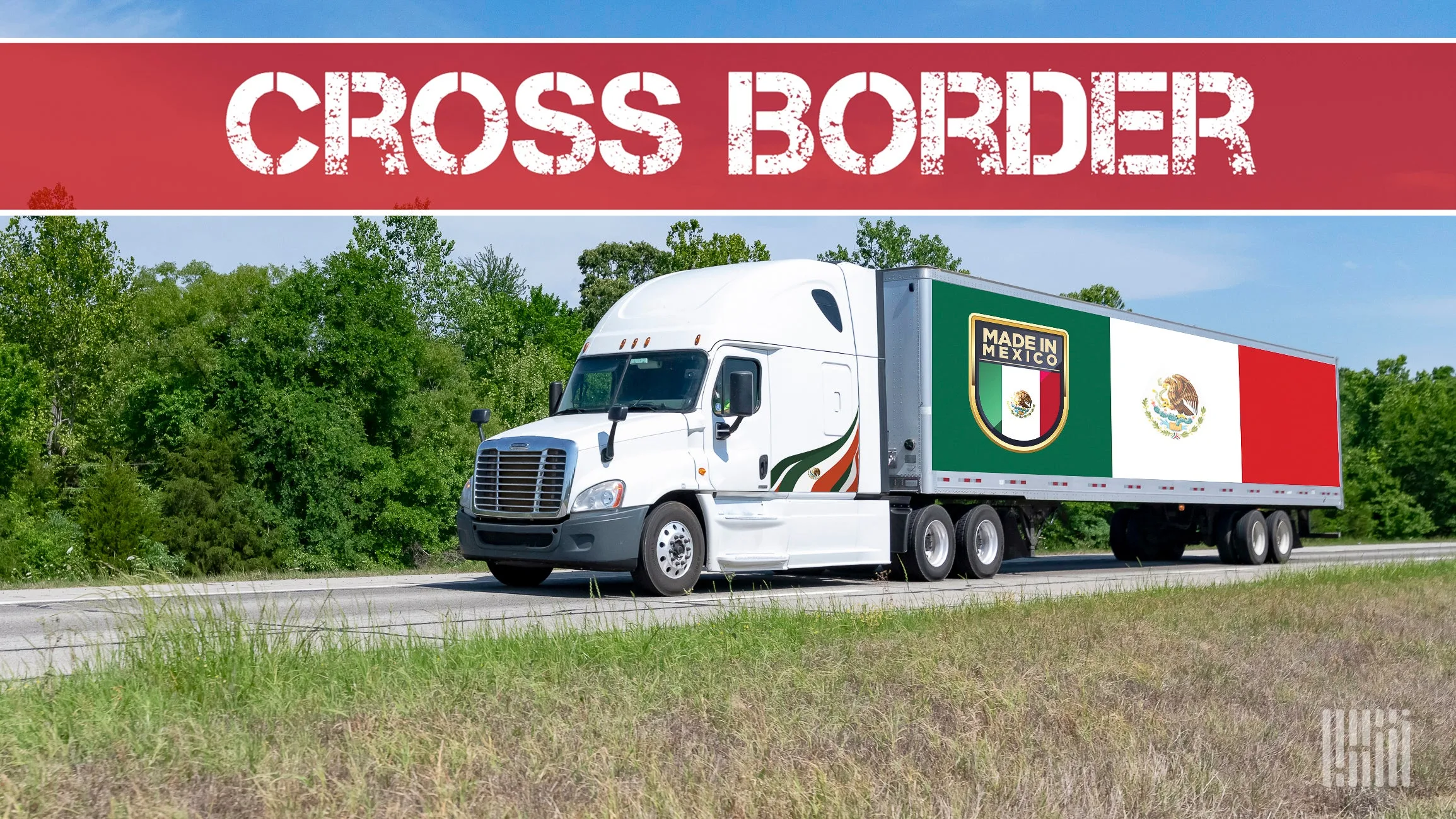
Borderlands Mexico is a weekly rundown of developments in the world of United States-Mexico cross-border trucking and trade. This week: Customs overhaul may reshape cross-border manufacturing, expert says; Transport Capacity Services opens Monterrey office to boost U.S.–Mexico freight; and WeShip Express relocates headquarters to Austin.
Customs overhaul may reshape cross-border manufacturing, expert says
Mexico’s sweeping 2026 customs reforms could tighten enforcement across the country’s manufacturing sector, while increasing compliance burdens for importers and customs brokers, according to Jonathan Todd, vice-chair of the transportation and logistics practice group at law firm Benesch.
In an interview with FreightWaves, Todd said the upcoming changes — expected to take effect Jan. 1 — represent one of the most significant shifts in Mexico’s trade governance in years.
“There’s a fair amount of duty evasion and smuggling of Chinese goods and other inputs into Mexico,” Todd said, describing a concern shared by U.S. manufacturers. “Stronger enforcement will help U.S. producers compete on a more level playing field.”
The customs reforms impose new obligations — and steep liabilities — on Mexico’s licensed customs brokers (agentes aduanales), who already operate within one of the strictest licensing systems in the world.
Unlike in the U.S., where importers can self-file entries with U.S. Customs and Border Protection, nearly all commercial imports entering Mexico must be processed by a broker.
Under the revised law, customs brokers will be jointly responsible with importers for undervaluation, misclassification and false declarations. Brokers must also report irregular transactions to authorities, a shift that Todd describes as potentially transformative.
“Mexico-based customs brokers are really the parties that will have the greatest compliance burden,” he said. “It’s not going to be impossible, but it’s not very often that you have conversations about jail time or multimillion-dollar penalties—and that’s now possible under the legislation.”
Related: New customs regulation could slow cross-border trade, expert says
Manufacturers operating under Mexico’s IMMEX program — critical for temporary imports that support maquiladora production — will face tougher controls.
Temporary imports must now align more tightly with production and re-export requirements, and companies whose IMMEX authorization is cancelled will have just 60 days to regularize or export their inventory. Todd said these rules could have uneven effects depending on the type of manufacturing operation involved.
“Any operation reliant on the program will need to comply,” he said. “For some operations, the compliance burden will be significant.”
Higher compliance costs could translate into higher production costs in Mexico, Todd noted. But logistics operations themselves—trucking and freight movement at the border—should see little structural change.
“I don’t expect it will change the way trucking runs cross-border,” he said. “The real change may be a higher cost of production in Mexico, but potentially a more level playing field for U.S. producers.”
The customs reforms also align with Mexico’s broader strategy ahead of the United States-Mexico-Canada Agreement joint review, next year, he said.
Mexico’s new customs posture arrives as the U.S., Mexico and Canada prepare for next year’s USMCA joint review—a process that could influence rules of origin, duty-free qualification thresholds and sector-specific provisions.
“The idea of USMCA and NAFTA was to create a strong North American trading bloc,” Todd said. “My personal reaction to this legislation is that it aligns with those goals.”
Transport Capacity Services opens Monterrey office to boost U.S.–Mexico freight
Transport Capacity Services (TCS) has opened a new office in Monterrey, Mexico, expanding its cross-border logistics footprint and strengthening support for U.S.–Mexico freight movements.
The Monterrey location positions TCS closer to one of Mexico’s largest manufacturing and shipping hubs, allowing it to better manage high-volume, complex operations on both sides of the border, the company said.
CEO Ben Enriquez said the expansion reflects continued demand for cross-border trade despite tariff uncertainty, noting that roughly 80% of Mexico’s exports are shipped to the U.S.
“While tariffs and market conditions remain uncertain, cross-border trade remains essential for many businesses and will continue growing,” Enriquez said in a news release. “Mexico is home to some of the world’s largest manufacturers and exporters. Establishing a presence there allows us to better serve our customers.”
TCS provides cross-border, domestic, intermodal and cross-dock services, supported by CTPAT-certified carriers and technology-driven freight visibility tools.
WeShip Express relocates headquarters to Austin
WeShip Express has relocated its corporate headquarters from Bradenton, Florida, to Austin, Texas, citing the city’s technology talent, entrepreneurial culture and logistics ecosystem as key drivers of its next growth phase.
The global logistics and compliance provider, which specializes in direct-to-consumer wine and spirits shipping, said the move will support expansion in compliance automation, temperature-controlled logistics and e-commerce fulfillment.
CEO Marc Goodfriend said the Austin headquarters will also enable job growth and strategic acquisitions as the company scales its technology and logistics platform through 2026.
The post Borderlands Mexico: Customs overhaul may reshape cross-border manufacturing, expert says appeared first on FreightWaves.