Overcapacity in the trans-Pacific container trade lanes blew up carriers’ plans for November general rate increases, which had briefly pushed prices to the U.S. West Coast up to about $3,000 per forty foot equivalent unit (FEU).
Rates dropped 32% last week to $1,900 per FEU, according to the latest update from Freightos (NASDAQ: CRGO) and fell an additional $100 this week, though they remain above the $1,400 per FEU yearly low from early October. East Coast rates fell 8% last week to $3,400 per FEU and are now at $3,000 per FEU this week, roughly back to early October levels.
“Last week’s vessel fire at the Port of Los Angeles does not seem to have had an impact on prices as operations have quickly recovered,” said Freightos research chief Judah Levine, in a note to clients. Rates are now about even with levels from early October before the rollout of the latest GRIs.
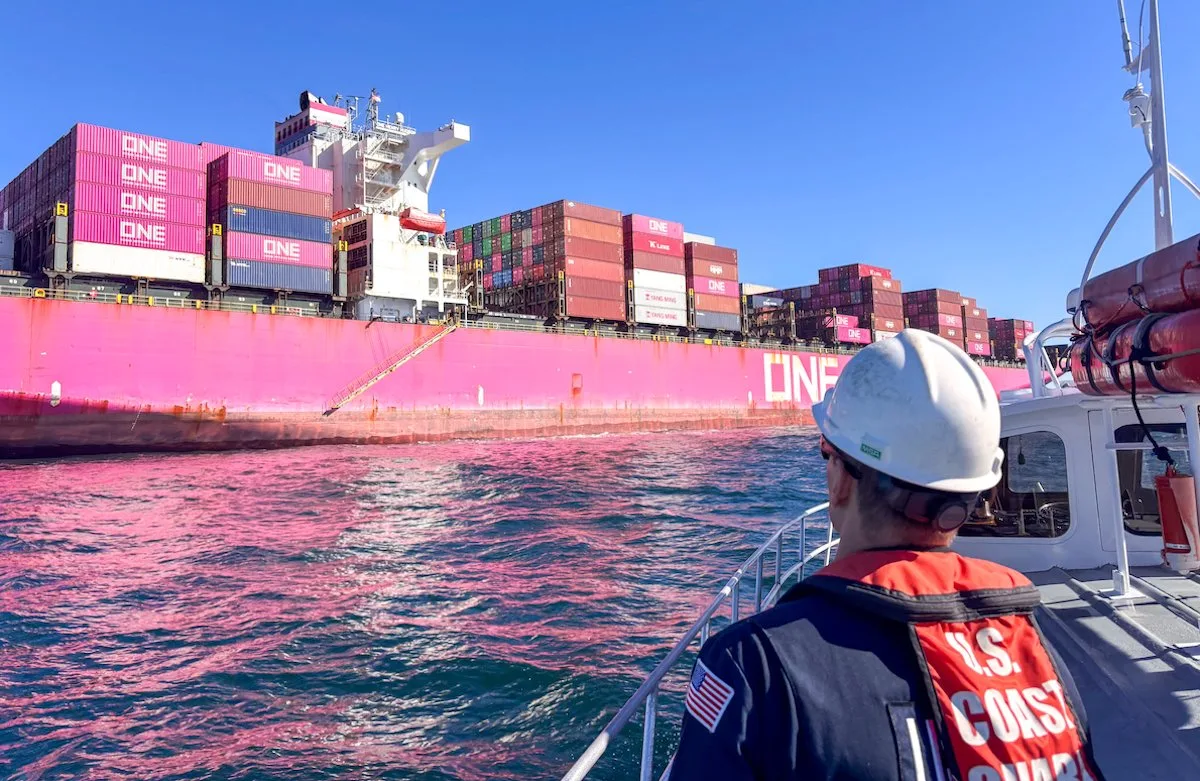
The vessel ONE Henry Hudson returned to berth after being towed to anchorage safely outside the port while emergency responders fought a stubborn fire belowdecks.
Ocean shipping was the subject of global trade conversations as a tenuous ceasefire in the Gaza war prompted talk of a return of the largest carriers to the Red Sea-Suez Canal route. CMA CGM said it would expand services; the French line has maintained some scheduled services since attacks on merchant shipping by Yemen-based Houthi militia beginning in late 2023 led most liners to divert on longer voyages around Africa.
But Maersk (MAERSK-B.CO), the world’s second-largest ocean carrier, said it had no imminent plans to return.
“While most carriers are not offering a timeline, ZIM’s (NYSE: ZIM) chief executive recently stated that a return in the near future is increasingly likely,” Levine said. “The shift of most of the 30% of global container volumes that normally transit the Suez Canal away from the Red Sea and around the Cape of Good Hope almost exactly two years ago added seven to 10 days and thousands of miles to Asia-Europe journeys and to some Asia-North America sailings as well.”
The return of container traffic to the shorter Suez route will lead to the sudden early arrival of ships, causing significant vessel bunching and congestion at already persistently congested European hubs, Levine noted. This resultant congestion will cause delays and absorb capacity, which could increase container rates on the affected lanes and potentially elsewhere, although carriers have plans for a gradual phase-in, with smaller vessels transiting first, to minimize the impact of the reset and mitigate vessel bunching.
A gradual transition would be less disruptive despite shippers’ likely demands for a quick return; it could take up to two months for schedules to return to normal during which a hurried process would weaken rates. A total of 2 million TEUs could be reinstated, according to industry estimates.
“The capacity absorbed through Red Sea diversions pushed East-West rates up to highs of $8,000-$10,000 per FEU in 2024 and set a highly elevated floor of $3,000-$5,000 per FEU during low demand periods that year,” Levine said. Rates on these lanes have consistently been significantly lower than last year, he added, with prices on some lanes reaching 2023 levels in early October.
Rate hikes in October and November on Asia-Europe lanes have been more effective. Prices to Europe and the Mediterranean are 40% higher than in early October at $2,500 per FEU and $3,000 per FEU as lines ratcheted up blanked sailings.
“Carriers are planning additional GRIs for December aiming for the $3,000-$4,000 per FEU-level as they continue to reduce capacity,” Levine said, with an announced labor strike in Belgium likely to absorb some supply, but there are signs that these increases may not take.”
Find more articles by Stuart Chirls here.
Related coverage:
Maersk: No timeline for Red Sea return
CMA CGM connects U.S. services with new Vietnam barge
Port Houston cargo surges in October as Foxconn eyes major expansion
Maersk relocates North American HQ to Charlotte
The post Asia-US container rates fall 32% in latest week appeared first on FreightWaves.