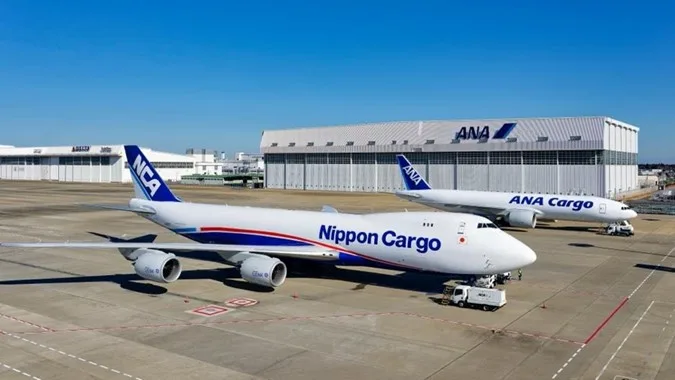
Cargo functions at All Nippon Airways and Nippon Cargo Airlines will be merged into a single company as part of a reorganization now underway following ANA’s recent acquisition of the all-cargo carrier, with NCA continuing to operate as an independent airline, according to an industry source with knowledge of the situation.
ANA Holdings, the parent company of All Nippon Airways, NCA and two small passenger carriers, announced Friday morning it has begun a strategic reorganization of the group-wide cargo business aimed at streamlining operations, improving efficiency and maximizing profitability. The news release offered few details, but said the changes would be completed by the end of March.
The source, speaking on the condition of anonymity to discuss the plans, said the company is still deciding on how to implement the reorganization. One thing that is clear is that Nippon Cargo Airlines will operate with its own air operator certificate, meaning it won’t be integrated into ANA’s airline operation.
ANA Holdings completed the purchase of Nippon Cargo Airlines on Aug. 3. ANA operates six Boeing 767 cargo jets and two Boeing 777 freighters, in addition to managing cargo carried by its passenger aircraft.
Nippon Cargo Airlines operates eight Boeing 747-8s. It also owns seven 747-400, five of which are on lease to Atlas Air to fly on its behalf and two of which are flown by ASL Airlines.
Cargo functions, responsibilities and decision-making at ANA are currently spread among different departments in the cargo and passenger groups, which is not unusual for a passenger airline. The structure slows decision-making and doesn’t always address cargo priorities.
ANA’s management wants to restructure the cargo functions into a single company that is focused on the management of cargo capacity operated by ANA and NCA, the source told FreightWaves.
“This would streamline and align decision-making for freighter schedules, sales, marketing, cargo handling, accounting, technology and other activities. The customer will be able to access all the capacity operated by the combined network through one sales channel, and one cargo handling terminal at each airport, as if ANA and NCA were one airline, while also maintaining the two air operator certificates,” the person said.
One of the earliest efforts at achieving synergies is expected to be the combination of cargo handling operations at Los Angeles International Airport and Chicago O’Hare Airport into NCA’s existing facilities, according to the source.
Folding Nippon Cargo Airlines under the ANA umbrella has already yielded positive results, including the joint utilization of cargo space and the launch of cargo codeshare flights to expand their respective cargo networks, the parent company said in the news release.
Under the code share agreement, which began on Oct. 26, ANA’s code appears on NCA Boeing 747 freighter services from Tokyo Narita airport to Chicago, New York, Dallas/Fort Worth, and Los Angeles in the United States and to Amsterdam, Milan, Italy, and Frankfurt, Germany. NCA’s code is on ANA 777 freighter routes from Narita to Chicago and Los Angeles.
A code share means two airlines have government approval to put their own flight numbers on the same aircraft, allowing customers to book with one carrier regardless of which airline operates the flight. Air cargo professionals say it is generally better to sell a flight with a code share rather than with an interline agreement because the airline can sell it as “its own flight” with its own flight number, even though the flight is operated by a partner. Customers usually can book the code share flight directly and track their shipment as if it were operated by the airline, assuming technical interfaces are in place.
Code-share operations are also considered more reliable than interline agreements, under which a carrier moves cargo for one leg of a trip and transfers it at an intermediate airport for carriage by a partner on a single airway bill. Interline agreements involve some form of revenue sharing. Many airlines give interline traffic lower priority, resulting in some cargo not always moving as booked.
In mid-September, ANA and Air Incheon began codesharing on freighter services operated between Japan and South Korea. Air Incheon completed the integration of Asiana Airlines’ freighter business on Aug. 1, and rebranded itself as AirZeta.
Click here for more FreightWaves stories by Eric Kulisch.
Sign up for the biweekly PostalMag parcel newsletter The Delivery here.
RECOMMENDED READING:
All Nippon Airways finalizes takeover of Nippon Cargo Airlines
The post ANA, Nippon Cargo Airlines begin to merge cargo businesses appeared first on FreightWaves.