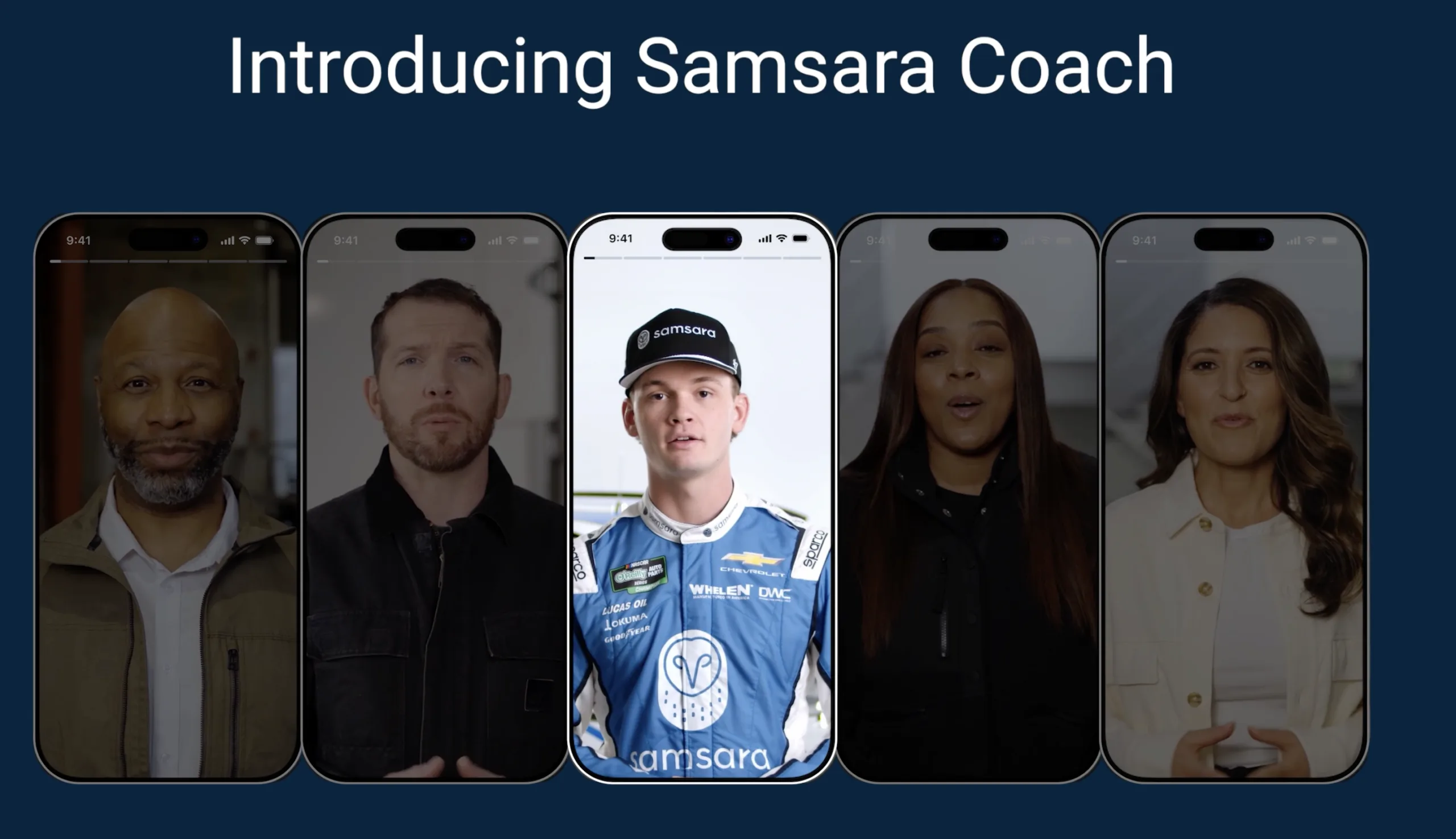
Fleet management technology company Samsara has launched Coach, an AI-powered coaching system designed to deliver personalized, real-time guidance to commercial drivers. The product, which will be unveiled during Super Bowl LX with a commercial featuring NASCAR champion Jesse Love, represents the company’s most ambitious effort yet to reduce the roughly 40,000 traffic fatalities that occur annually in the United States.
The system builds on Samsara’s existing platform of in-vehicle cameras and sensors that monitor driver behavior. For nearly a decade, the company has deployed dual-facing dash cams that use artificial intelligence to detect more than 50 specific behaviors—from following distance and mobile phone usage to drowsiness—logging events and uploading them to a central database. Coach takes this foundation and adds a layer of generative AI that analyzes patterns across the data to provide nuanced, individualized feedback.
“Our safety product’s sole objective is to prevent crashes. Ninety percent of crashes are caused by human error,” said Johan Land, Senior Vice President of Product and Engineering for Safety and AI at Samsara. “The path toward preventing accidents is to help humans improve and help drivers become safer. That’s the name of the game–that’s the whole game.”
Land drew a direct comparison between professional driving and elite athletics, noting that while coaching has become a sophisticated science in sports, where a player might receive upwards of 100 coaching moments during a training session, professional driving lacks similar support systems despite the life-or-death stakes involved.
“It’s baffling that coaching is the recognized way of improving humans and has been perfected in sports, but for professional driving it’s not even remotely as good,” Land said.
The Coach platform works through multiple channels. Managers and supervisors gain tools to oversee and guide their drivers, while drivers themselves interact with an AI avatar through Samsara’s mobile app for sit-down coaching sessions. In high-risk moments like drowsiness or speeding, the system can initiate live, two-way voice check-ins through the dash cam to verify driver responsiveness.
Customers have already successfully deployed this technology.
“Samsara Coach’s two-way, in-cab AI voice coaching helps us support our national repair technicians at scale,” said Rocco Speziale, Senior Director of Asset Protection at Sears Home Services.
One of the key differentiators, according to Land, is the system’s focus on behavioral patterns rather than isolated incidents. “It’s very important to remember that most drivers are good, and every driver wants to be good,” he said. “But to have effective coaching, you need deep analysis, tailored to the individual and what the individual is going through.”
The business case for such technology is compelling. Fleet operators typically run on single-digit profit margins, with vehicle-related costs consuming most of their expenses. Crashes represent a substantial portion of that cost, particularly as nuclear verdicts, large jury awards in trucking accident cases, have reached a median of $51 million, with crash costs increasing faster than inflation, Land said.
Systematically coaching drivers with individualized feedback was effectively impossible, but now large carriers are embracing the opportunity. Jordan Carriers, one of the largest private employers in Mississippi, reduced daily coaching needs by 93% with Samsara Automated Coaching.
“Automation is helping me manage coaching for nearly 1,000 drivers,” said Otis Anderson, Safety Compliance Analyst at Jordan Carriers.
Samsara’s data suggests the technology delivers measurable results. According to the company’s fleet safety report, which draws from 70 billion minutes of driving data annually, customers who install the cameras see a rapid 30% or greater reduction in crashes. Those who implement the full coaching system—including dual-facing AI dash cams, in-cab alerts, and coaching—report crash reductions of up to 70% to 73% over 30 months.
The company’s analysis of anonymized data from thousands of fleets shows that within the first six months, customers typically see a 48% decrease in harsh events, 4% decrease in speeding, and 84% decrease in mobile phone usage while driving. At 30 months, those numbers improve to 69%, 23%, and 96% respectively.
“Every professional athlete has a coach to help them reach peak performance; now with AI, we can finally offer that same advantage to drivers,” Land said. “Samsara Coach moves us beyond flagging errors. Our multimodal coach understands the context of a driver’s trip and communicates with the nuance of a human. This is how we transform safety at scale.”
The system also attempts to address the isolation inherent in long-haul trucking. Land acknowledged that driving is often a lonely profession, where conversations with company representatives typically occur only when something has gone wrong.
“When they talk to someone from their company about their driving, it’s usually because something bad happened,” he said. The AI avatar, he explained, can function more like a supportive peer, offering recognition-first feedback and weekly performance recaps that prioritize positive reinforcement.
Organizations using Coach can select from pre-set avatars, including Jesse Love, or configure avatars that replicate a manager’s likeness. The system also incorporates gamification elements, allowing drivers to track achievements like maintaining safe speeds for extended distances and potentially tying performance to rewards programs.
The post Samsara unveils AI-powered Coach, promising to radically reduce truck accidents appeared first on FreightWaves.