
Port and terminal planning has always aimed for precision. Berth windows are allocated, vessel stowage is analyzed, yard blocks are reserved, equipment is assigned, and labor is scheduled—all before the first container is moved. On paper, the plan works.
In reality, perfect planning has never existed in container terminals and not because planners are inadequate. The reason is structural.
The Structural Limits of Port Planning
Most terminals operate under conditions that make perfect planning fundamentally impossible. Planning must be completed under intense time pressure, often days or even hours before vessel arrival. Critical information such as final stowage, late container arrivals, transshipment changes or equipment availability – is incomplete or provisional. At the same time, the operational environment itself is constantly shifting.
Vessel arrival times fluctuate. Yard density changes hour by hour. Equipment health evolves with use. Labor availability is affected by weather, regulations, and human constraints. These variables are not exceptions – they are the normal operating state of modern ports.
As a result, planning is an exercise in approximation. Decisions are made with partial visibility and simplified assumptions, not because planners choose to ignore complexity, but because traditional planning systems cannot fully model it. These limitations are structural, not human failures.
When Execution Begins, Reality Takes Over
The moment execution starts, the plan meets reality and divergence begins.
Equipment assigned during planning may be unavailable due to breakdowns or reallocation. Yard congestion emerges as container flows do not match forecasts. Trucks arrive in unplanned peaks. Transshipment containers miss connections. Priority changes are issued mid-operation.
At this point, the plan can no longer be followed as designed. Manual interventions become necessary. Supervisors reroute equipment. Yard strategies are adjusted on the fly. Work queues are reshuffled. Decisions are made based on experience, intuition, and urgency rather than systemic optimization.
This is not a sign of poor execution. It is a coping mechanism.
Exception Handling as the Hidden Operating Model
Exception handling fills the gap between plan and reality. Initially, it is a necessary response to unpredictability. Over time, however, reactive decision-making becomes the dominant operating mode.
Terminals adapt their organizations around firefighting. Skilled staff are valued for their ability to “fix problems” rather than prevent them. Informal workarounds emerge. Planning accuracy is deprioritized because everyone expects the plan to be overridden anyway.
What starts as flexibility slowly becomes institutionalized inefficiency. Resources are over-buffered to compensate for uncertainty. Equipment utilization drops. Yard reshuffles increase. Labor stress rises. Variability compounds variability.
The terminal becomes very good at reacting – but never escapes reaction.
The Real Root Cause: Uncertainty Before Execution
The core issue is not execution discipline. It is uncertainty embedded in planning.
Traditional planning tools operate in two dimensions, with static assumptions and limited foresight. They cannot continuously reconcile vessel operations, yard dynamics, equipment constraints, and time-based interactions. Conflicts are discovered only when they physically occur such as on the quay, in the yard, or at the gate.
By the time a conflict is visible, it is already expensive.
From Reactive Operations to Super-Intelligent Planning
Super-intelligent planning and digital twin–based operations address the problem at its source.
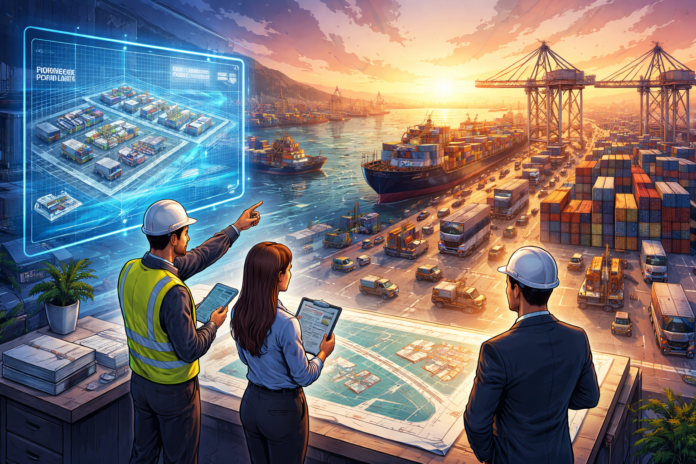
Instead of producing a single static plan, a digital twin creates a living, high-fidelity model of the terminal in real time. It integrates vessel geometry, yard topology, equipment behavior, operational rules, and historical performance. Planning is no longer an abstract exercise – it is a simulated execution.
Near-future scenarios can be tested before moves are committed. Equipment conflicts are predicted hours or days in advance. Yard congestion is identified before it forms. Vessel productivity impacts are visualized in 3D, not inferred from averages.
This approach does not eliminate uncertainty but it dramatically reduces it before execution begins.
Predicting Conflicts Before They Materialize
The key shift is timing. Instead of reacting to exceptions after they occur, super-intelligent systems surface conflicts while they are still optional.
Planners and operators can evaluate alternatives with clarity. Decisions are made with full awareness of downstream effects. Manual intervention becomes deliberate rather than desperate. Execution aligns more closely with intent – not because reality became simpler, but because visibility became deeper.
Exception handling does not disappear, but it shrinks. It becomes the edge case, not the operating model.
Why This Transition Is Now Essential
The transition from reactive planning to super-intelligent, digital twin–driven management is no longer optional.
Costs continue to rise. Service reliability is under constant scrutiny from shipping lines and cargo owners. Workforce sustainability is becoming a critical constraint as experienced operators face burnout and skill shortages.
Reducing inefficiency is not just about productivity – it is about making terminal operations manageable, predictable, and humane.
By addressing structural uncertainty at the planning stage, terminals can lower operational costs, improve schedule reliability, and reduce cognitive load on their workforce. The organization shifts from constant correction to controlled execution.
Planning Will Never Be Perfect – But It Can Be Predictive
Port planning will always involve uncertainty. That reality does not change.
What can change is whether uncertainty is discovered during execution or anticipated before it.
The future of terminal operations belongs to those who stop treating imperfection as a failure to manage, and start treating it as a system design problem – one that super-intelligent planning and digital twins are finally capable of solving.
Author: Valerie Nguyen
The post From Perfect Plans to Real Operations – Why Ports Must Rethink Planning appeared first on Container News.