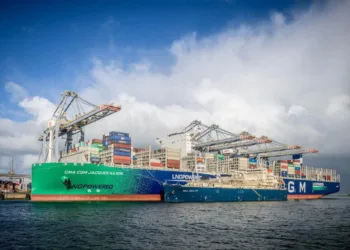
The port authorities of Valencia and Santos have signed a memorandum of understanding to create a green maritime corridor. The agreement aims to promote the decarbonization of maritime transport between Europe and South America.
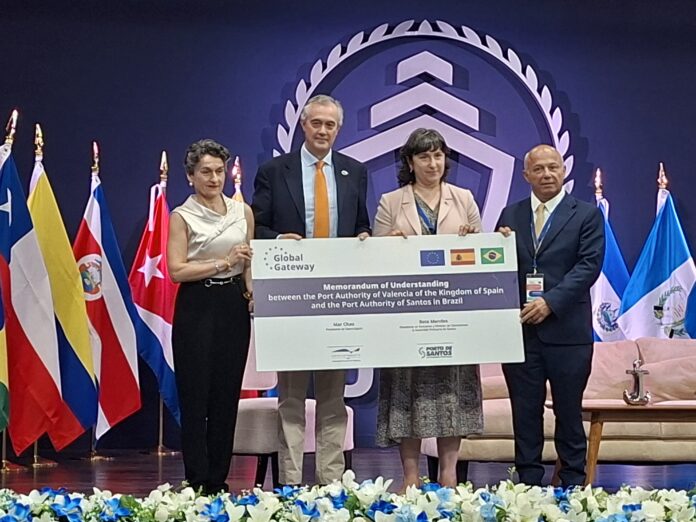
The ports signed the deal during the Global Gateway Green Shipping Corridors and Hubs Regional Workshop in Panama. Valenciaport President Mar Chao and Acting President of the Port Authority of Santos Beto Mendes attended the signing at the International Maritime University of Panama.
Félix Fernández Shaw, Director for Latin America and the Caribbean at the European Commission’s Directorate-General for International Partnerships, also participated. Isabela Matusz, representative of the Delegation of Panama, attended the event.
Coordinated Decarbonization Strategy
The Santos-Valencia corridor reinforces Valenciaport’s decarbonization strategy. The agreement enables both ports to coordinate actions promoting low- or zero-emission fuels. The partnership will advance electricity supply to ships in port and terminal electrification.
“It is a key project for advancing the construction of Net Zero and resilient logistics chains,” said Chao. The initiative supports logistical efficiency through advanced digital technologies.
Beto Mendes explained that decarbonization forms part of a structured strategy for energy planning. “The green maritime corridor between the Port of Santos in Brazil and the Port of Valencia in Spain is a milestone in international cooperation,” he stated.
The initiative aligns with Santos’ Energy Master Plan. Mendes said it strengthens technical and institutional cooperation and contributes to sustainable, innovative, and resilient solutions for global logistics chains.
Strategic Trade Gateway
Santos currently leads South American ports in import and export traffic with Valencia. The green corridor will strengthen both ports’ positions as strategic gateways for trade between the continents.
Chao emphasized the shared commitment to sustainability. Valencia aims to achieve climate neutrality by 2035. Santos is strengthening its role as a leading green hub in Brazil and Latin America.
Valenciaport closed 2025 with the presentation of its Net Zero Emissions plan. The plan envisages €900 million in investment, either planned or already underway. It includes infrastructure for port energy self-sufficiency and a climate change adaptation plan.
Collaboration Framework
The memorandum establishes cooperation with shipping companies, shippers, energy suppliers, and research centers. The framework promotes adoption of sustainable fuels including LNG, biofuels, green methanol, green ammonia, and hydrogen. It also advances carbon capture and reuse technologies.
Both port authorities will facilitate technologies aimed at reducing emissions and improving energy efficiency. They will advance the transition to low- or zero-carbon energy sources. The ports will collaborate with participants to support emissions reduction along designated routes.
The initiative forms part of the Global Gateway strategy. The European external investment program strengthens strategic partnerships and accelerates the transition toward more sustainable maritime transport. It focuses particularly on Latin America and the Caribbean.
The agreement moves the ports forward in creating a more efficient, safer, and environmentally friendly maritime corridor. Santos and Valencia consolidate their leadership in the decarbonization of transatlantic maritime trade.
The post Valencia and Santos create green corridor to decarbonize transatlantic trade appeared first on Container News.