The ongoing battle between Amazon and the Teamsters has played out in multiple arenas this fall, a series of skirmishes in which neither side can claim to have landed a knockout punch.
The scorecard for autumn 2025 includes a unionization drive at Amazon in Kentucky that found the union declaring victory, a claim that is challenged by the company; legislation in the city of New York City that could raise questions of what a local government can do as it seeks to enter the fray on the side of the Teamsters; and an ongoing federal process at the National Labor Relations Board (NLRB) that so far can be seen as surprisingly positive for the union-driven effort.
The most recent development came last month in the Bluegrass State. A group of Amazon (NASDAQ: AMZN) employees who drive class 8 tractors at the SDF9 Amazon facility in Shepherdsville, south of Louisville, were touted by the Teamsters as the first group of the company’s tractor trailer drivers to join the Teamsters.
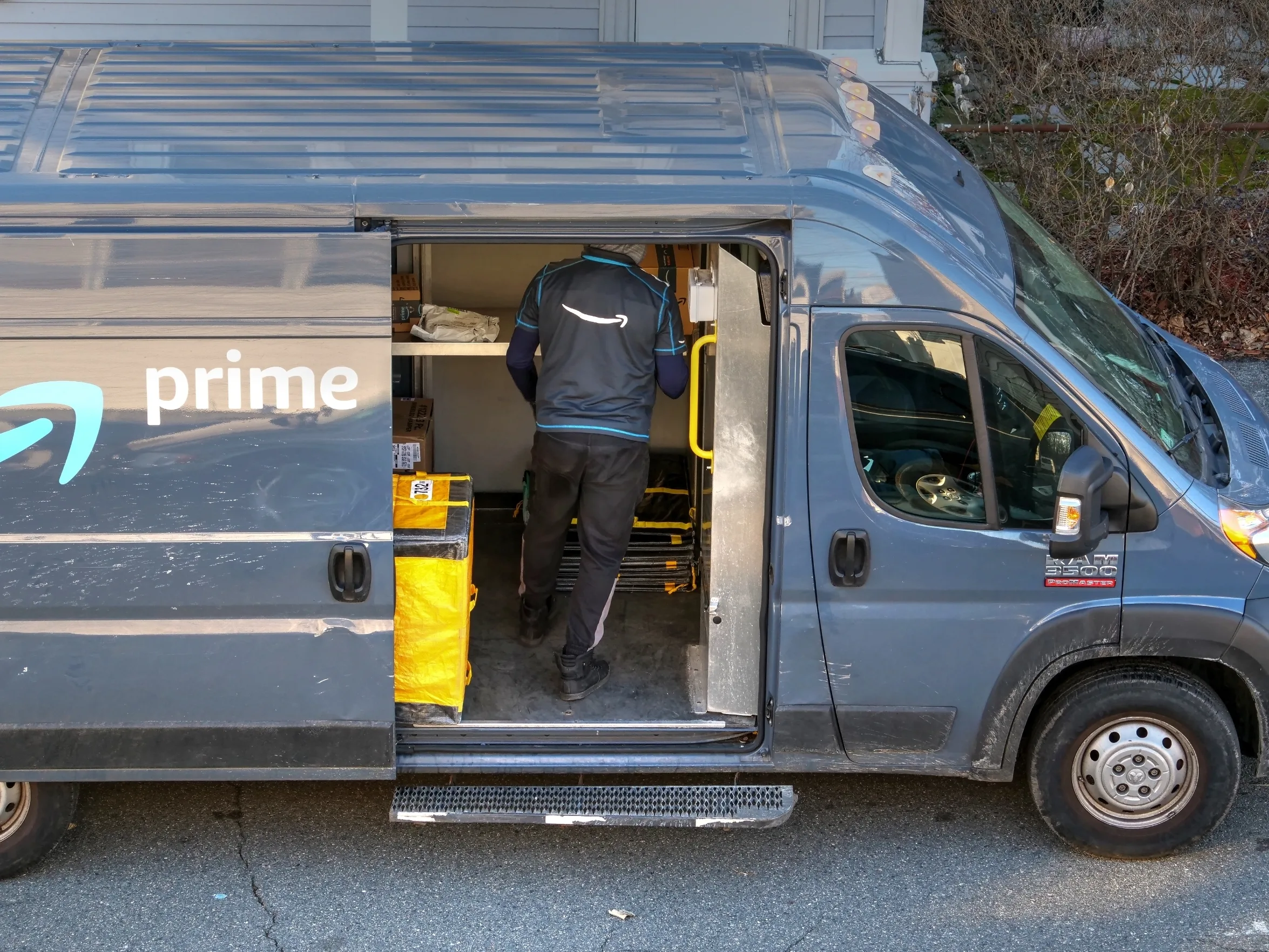
While there have been other organizing drives at Amazon’s direct service providers (DSPs) around the country that led to the union declaring success, workers at those companies who deliver packages to homes and businesses do not have Amazon listed as their employer when they get their W-2 statements each year for filing their income taxes. The Teamsters refers to them as “Amazon Teamsters,” but they are not employees of Amazon, at least not yet. (More on that later).
Kentucky drivers get their W-2 from Amazon
But the Kentucky drivers who work for Amazon’s Transportation Operations Management (TOM) team in Kentucky do have Amazon as their W-2 employer. The only other W-2 employees in the Amazon network who have voted to be represented by the Teamsters are at a Staten Island, New York warehouse. They first voted to organize under a grassroots union that later chose to become part of the Teamsters. Negotiations at Staten Island have yet to result in a contract for the workers.
What does not appear to have happened at the Amazon Kentucky facility was a representation vote conducted under the auspices of the National Labor Relations Board (NLRB). Admittedly, the list of recent elections reported by the NLRB is short, since the government shutdown led to almost two months of no activity.
But sources close to the election said the unionization victory claimed by the Teamsters came through the submission of a letter by the Teamsters with a majority of the rank-and-file requesting recognition under the terms of the NLRB’s CEMEX decision from 2023.
As the Fisher Phillips law firm described the CEMEX decision, “No longer could employers simply refuse to recognize the union while assuring their employees of the opportunity for a secret ballot election.”
Instead, when presented with the signatures of the majority of employees, an employer could “concede” and recognize the union, “challenge” and demand a secret ballot vote, or “fight” the validity of the union’s certification, Fisher Phillips said.
Teamsters representatives did not respond to emails sent by FreightWaves. But in its announcement of the action in Kentucky, the union made no reference to an election, and seemed to refer to the process leading up to the submission of signatures by saying drivers seeking to join the Teamsters “have been quietly organizing for more than a year to prevent Amazon from union busting.”
That process is known in some quarters as “card check,” though Teamsters representatives have pushed back against the use of that term to describe an action driven by the precedents of the CEMEX decision.
Amazon doesn’t see it that way
Eileen Hards, a spokeswoman for Amazon, did supply FreightWaves with a comment.
“Based on the Teamsters’ history of misrepresenting the facts, we question the accuracy of their claims regarding employee support at our SDF9 facility,”: she said in an email to FreightWaves. “Our employees have the choice of whether to join a union, and the fact is we already provide much of what the Teamsters are requesting, including competitive pay, health benefits on day one, and opportunities for career growth.”
Legislation in New York City seeks to define employees
In New York City, the battle is over a bill originally sponsored by City Council member Tiffany Caban. Caban was at the protest at the Amazon facility in the borough of Queens in September which arose out of Amazon ending the contract of a company called Cornocupia Logistics, a DSP that operated out of that site. A representative of her office told FreightWaves at that event of Caban’s plans for the legislation.
The bill was introduced in September with a long list of co-sponsors joining Caban. However, the City Council’s website on legislation shows it having not advanced beyond the committee stage.
The goal of the bill is to take the drivers (and other employees) at DSPs and effectively make them Amazon employees.
As a provision in the bill states, “workers providing core delivery services on a part-time or full-time basis shall be directly employed by the facility operator.” It makes a similar statement for workers providing “core warehouse services.”
Amazon DSPs pick up their goods to be delivered at Amazon-owned facilities. For example, the protest in Maspeth was at an Amazon-owned site designated DBK4.
Another part of the bill would affirm the role of Amazon as employer in another way: “Except as otherwise provided in this section, contracting with any third parties, including staffing agencies or other subcontractors, for the performance of core delivery services or core warehouse services, is prohibited.”:
The impact of the bill could be sweeping; Amazon is not mentioned specifically in the legislation and there are plenty of other warehouses supplying goods to third party providers delivering under the name of a well-known company but who are legally separate entities.
Can NYC make those decisions?
Greg Feary, president and managing partner at the trucking-focused Scopelitis law firm, said of the Caban bill that “there’s not a lot of meat on the bones.”
But the bigger question, he said, is “whether New York City has the jurisdiction to do this.”
At issue would be whether the activity of picking up packages for local delivery and not crossing state lines could still be considered interstate commerce, which can not be regulated by states or localities.
The question is significant enough that the Supreme Court is taking up the issue this term in the so-called Flowers Foods case. The issue in Flowers Foods is whether drivers making deliveries of baked goods are involved in interstate commerce, even if their entire route is within one state.
As Feary described the issue, not just in Flowers Foods but in general, “Interstate is defined in two different ways under the law, whether there’s a crossing of state lines, or whether the items that are being delivered are a continuation of an out-of-state move.”
Lower courts in Flowers Foods have made the latter determination; that is what is being appealed to the high court.
Feary also noted that any question of the ability of New York City to regulate delivery services under the Caban bill would also raise the issue of preemption under the Federal Aviation Administration Authorization Act.
That 1994 law prevented a state or locality from passing any law or regulation that might impact a transportation “price, route or service.” It has been a key focus of legal battles regarding California’s AB5 independent contractor law and broker liability.
While the Caban bill has been described as one that would make Amazon a joint employer with the DSPs, Joshua D. Nadreau, regional manager partner and vice chair of the labor relations group at law firm Fisher Phillips, disagreed with the characterization.
“What it’s requiring companies to do is employ directly their delivery drivers,” Nadreau said in an interview with FreightWaves. “It’s obviously a response to either inaction or a lack of perceived action from the federal government on the issue of joint employers generally.”
If the Caban bill is not acted on by the end of this month, which is the end of the current City Council session, it will need to be reintroduced in the session that starts after January 1.
Positive news for the union at NLRB
Meanwhile, the question of just who is the employer of an Amazon DSP driver is at the heart of another ongoing federal action. And so far, it’s played out in the Teamsters’ favor.
A case winding its way through the maze of the NLRB appellate system is testing an earlier pair of findings that workers employed by a DSP named Battle Tested Strategies (BTS) working out of Palmdale, California have Amazon as a joint employer.
(As an aside, BTS had its status as a DSP pulled by Amazon. The Teamsters has said it was in reaction to BTS recognizing the union; Amazon has said it occurred for a variety of reasons related to nonperformance).
Those earlier NLRB decisions came under a Biden administration NLRB. That raised questions whether a new Trump administration would continue to make the argument that Amazon was a joint employer with its DSPs, or would reverse course and argue the opposite.
But according to September reporting by Bloomberg, there was no change by Trump administration representatives at a Los Angeles hearing that was the latest stop in the NLRB appeals process.
As the Bloomberg article noted, the newly-appointed chief prosecutor at the NLRB, William Cowen, “has forged ahead with the Palmdale case, accusing Amazon of violating the 1935 National Labor Relations Act.”
According to the Bloomberg report, Sanam Yasseri, an attorney with the NLRB, told the NLRB judge in Los Angeles that “Amazon structured its logistics network to maintain all the benefits of control while denying any responsibility as an employer.”
“It controls every minute of the drivers’ day,” Yasseri said, according to the Bloomberg report.
Is it a duck?
That is aligned with what the Teamsters have said for years, its version of the “if it walks like a duck” argument: DSP drivers pilot a truck with Amazon on the side, they wear Amazon uniforms, and the owners of the DSPs are under tight control of the company. Hence, they are effectively a joint employer.
Amazon’s comment on the proceedings from Hards was to reiterate that “as we’ve said all along, there is no merit to any of these claims. We look forward to showing that as the legal process continues.”
As the process proceeds, it’s notable that the Trump administration’s nominee to be NLRB is Crystal Carey. She is opposed by the Teamsters, and the Bloomberg article on the NLRB Los Angeles hearing notes that in private practice she has represented Amazon in the past.
Nadreau, reviewing the NLRB process, said the next step is for the administrative law judge that heard the arguments in Los Angeles to “make a finding of an unfair labor practice that can then be appealed to the full NLRB in Washington.” The full board–which at present is not operating with a quorum–would then rule on the issue but can make modifications. The case can then move to federal court.
How those cases have gone so far is likely why Amazon and the Teamsters describe the joint employer status of Amazon so differently.
The Teamsters says Amazon is a joint employer, citing the decisions handed down so far in the California case.
But Amazon sees a process that has not reached its ultimate conclusion, so therefore there is no definitive finding that the company is a joint employer.
More articles by John Kingston
Teamsters grows influence in Amazon’s food network via UNFI success
A ‘jobs apocalypse’: panel at Trimble eyes AI’s future in logistics
Likely 1st AB5 trucking enforcement action in California snags 3 companies
The post Inside the Amazon-Teamsters showdown: What’s next? appeared first on FreightWaves.